Sunday, December 5, 2010

#42-Machete (2010) (Quicky Review)

Machete

Machete is a film that runs into problems quick and often. It's main problem comes from the fact that it is indeed an adapted screenplay, and the concept was originally designed to only run about two and a half minutes, and as two and a half minutes, even maybe at a half hour long, Machete would have been genius. It would have been one of my favorites. But at an hour and forty-five, it just runs to long.

The plot is tired and boring and brought nothing new to the table. But was it suppose to? It is one of those throw-back things that seem to be so hip these days. Danny Trejo's family was murdered, he's been trained by the C.I.A., F.B.I., D.E.A. and all the rest. So, revenge.

The film boasts an impressive cast from the B and A-List Teams. Danny Trejo, Michelle Rodriguez, Robert De Niro, Steven Sagal, Cheech Marin, and others all make their way into Robert Rodriguez's interesting little grindhouse throwback, and you can tell that everyone involved just had a fun time making the picture. Its over-the-top, it's gratuitious, and (at times) its very fun. Just to sit back and watch it absorb in itself and weird universe that it makes. But the fun times are few a far between. Whereas I really enjoyed Death Proof, and Planet Terror, Machete just doesn't have the same flare to it.

It's pacing and direction feels very, very clunky. It seemed like a series of random events thrown together. Which it originally was, a trailer that wasn't intended to be a film. But once the idea of the film came together, it just seemed like more random events thrown together, to make the random events that took place in the trailer seem a little more plausible, and to actually happen onscreen. Not to mention the final battle that takes place between three different groups is just awful. Its not fun. Its not action-packed. Its exciting. It just felt very off.

Machete is a decent rental at best. The acting is fun, the story is stupid, and it has moments of real hilarity. But there are too few, and there certainly aren't enough for the movie to be an hour and forty minutes long. These grind-house throwback films can be good, they can be really good, but this isn't one of them. The cast had a good time, and its fun to see all these people together, and the few moments that work, really do work, but it's just a tiny idea, stretched far to thin.

I Give Machete A:
2/5

Wednesday, December 1, 2010

Antichrist: A Theory and Analysis

One of the hardest things about trying to give a theory on a film like Antichirst in particular, is how many interpertations of it can be made, and how after the reaction to the film, Lars von Trier doesn't appear to be giving out answers anytime soon. Another reason being is that it is a film of pyschological meltdown and confusion, giving any number of different possibilites for what is happening in reality. Combined with the films bizarre and surreal imagery and overall difficult tone, it is a hard film to pin to one certain message. I would also like to note that all this is written after a single viewing, and some serious note-taking. This post may change over time with additional viewings (if I dare.)

Being that the film is about a psycho-analysis of a woman by her husband, it must first be noted that some things may or may not be happening in reality. He and She are both deeply flawed people, and are emotionally unstable after the death of their son Nic. She expresses her sadness and anger through increasingly violent tendancies, and overall erratic behavior. But, nearly also as strange, is how easily He deals with it. He copes by trying to help She cope, almost never showing any emotional sign of the death of his son at all, except for a few tears at the beggining, which I'll get to later. The film also plays with the idea of Satan, Evil, and Human Nature, which all may have a metaphysical higher-power associated with them, and thus explaining some of the more outlandish, and impossible scenes the film depicts.

From the start, the film does have some overtly religious metaphorical connections. The cabin in the woods being called "Eden" and so forth. A scene towards the beggining, when He is helping She make a list of places She is afraid of, She mentions "the woods." He investigates further asking: "Any woods in particular?" Which is when we learn that She is scared of the woods around Eden, which He labels in parenthesis as (garden). Another play on the biblical tale of The Garden of Eden. Further religious themes come later in the film, such as when they are walking toward the cabin, and She claims that the ground is burning, and reveals burns on the bottom of her feet, as if Hell rested over that single patch of Earth. More details are added about this when She claims that "Nature is Satan's church", which allow us to make the assumption, of Eden being Hell. An interesting paradox and statement for the film to make. Even more religion inspired themes come in the form of She's earlier thesis paper, which is about the misogynistic treatment of women in the 1600's, for they were thought for witches, and the films title itself; Antichrist.

Though many paradoxes and connections can be made, and are obviously there, I am willing to write them all off. When She first speaks of Satan, He reacts with a mix of disgust and surprise. Allowing us to assume that She wasn't at all religious before the death of their son, and emotional break-downs. The two emotions, Disgust and Surprise allow us to say that 1) She wasn't religious and 2) He wasn't and still isn't. From here there are three possible ways for this to be taken.

1.He and She aren't religious, and therefore none of the impossible occurences can be attributed to a higher power.

2.He and She aren't religious, and are therefore being punished for their lack of faith by inserting the Antichrist into one of the characters.

3. He and She aren't religious, and are trying to be enlightened by a higher-power, but are unfourtanetly being swayed because they are standing over Hell.

However, I am going to say that the most likely answer is the first. None of the impossible occurences can be attributed to a higher-power. Cinemas depiction of religion usually comes in the form of religious characters, only religious characters exclaim to have any connection to God (unless the film is directly for religious purpose, at which point they will attempt to sway non-religious chatacters to their side). Since our characters are not religious, and all forms of religion on pushed on them by their own psychologic incapabilites, we can assume that they are not allowed to be effected by the Hand of God, or the Hand of Satan.

The film is notorious for its distictive look and unreal perceptions, many of which it has become famous for. The so called "Chaos Fox" and tree made with roots of human limbs and so forth. But what I think is interesting first and foremost are the animals. The first animal we encounter is a deer. The scene has He all by himself, after She has run-off, terrifed of the woods, when He finds a deer. First glance lets us know that this deer isn't like other deers. Usually when a deer meets with a human they dart into the nearest possible bush, or forested area (I live on the North-West coast of Oregon, the things are everywhere), but this deer just stands and stares at He. Not moving. Not Blinking. But aside from this the deer is pretty normal. Until it turns and we find that it has a stillborn fawn hanging out of its uterus. A possible, and in fact quite clear reference to the death of their child. In another scene where He is alone, a dead fox re-animates and begins to eat it's own entrails, and claims that "Chaos reigns". The third animal comes once more when He is alone, hiding from She in what appears to be a rabbit-hole, where a dead bird re-animates and begins cawing. This gives away where He is hiding and He kills it multiple times, only to have it re-animate and begin making noise again.

These all share a few things. Easily that they are all animals doing impossible things, which based on my theory above aren't really there. The deer isn't really there, the fox doesn't talk, the bird doesn't come back to life, they are all complete metaphoric symbols that have absoloutly nothing to do with the nature of the forest. However, another thing to notice is that all these animal occurences happen only with the character of He, and only when He is alone, without She in frame, for whatever the reason may be. The only animal scene that happens with She on screen is when a baby bird falls from it's nest dead, only to be swept up and eaten by a Raven, something that could very easily happen in real life. This is also something that I will touch on later.

Now the question. What do all these animals mean? The three beggars as they are so called. In the scene when He ventures into the attic to find She's scrawled thesis paper and crazy writing, She has carved into the desk a picture of the three beggars. The three-beggars have names carved into them as well, Grief, Pain, and Despair, which also share their names with the names of the chapters the film is broken up into. A pretty clear connection between what each one represent, and how, in the conclusion, where all three beggars must arrive before She will kill He, this means that all three emotions, Grief, Pain, and Despair, must arrive in the both of the characters, in their complete  form, in their full, natural forms, untouched by their original oddities, before He or She dies.

Another connection I would like to make is when She has run out of the house and begins masturbating on the tree. The tree starts out normal, like a tree looks, it is only when He enters the scene that the tree seems to ascend from it's basic form, and grow these strange human limbs, which appear to be the limbs of the dead, possibly buried underneath. So now we have He as the only one who had the delusions of animals, and He as the one who seemingly caused the appearance of the dead bodies, thus insinuating that there is something definatly wrong with He.

Which isn't to say there isn't something definatly wrong with She. The film reveals to us, very breifly, and without much else said about it, that She had been putting Nic's shoes on his wrong feet. And She has been doing this for a significant amount of time. It also reveals to us that she might have done this purposfully, when Nic starts crying, and She does nothing. Similairly, Nic fell out of a window, just as the dead baby bird fell out of the nest, only to be consumed by a Raven later. Early on in the film, She explicitly states that He is not paying enough attention to She, and after the death of Nic, She gets literally all the attention from He, who then thinks he can cure her. Is it possible that she wanted Nic dead? To get the attention of He? That putting the shoes on the wrong feet was just the start of a very severe pyschological damage? I think that when the Raven eats its own child, it is a clear connection with She having wanted Nic dead.

Both characters are incredibly psychologically damaged, have little-to-no connection or sense of reality, and quite simply are insane. The final straw for She comes in the finale where She has conivinced herself that all women are evil (a very clear sign in biblical texts, which throughout the film she becomes increasingly attached to) and begins to genitally mutilate herself and He. An incredibly clear sign that she has lost it. Now is when they are both completed filled with the three 'beggar' emotions, and the three animals show up. Except something happens. Whereas She has had the power for the entire film, she has been the most violent, and from the beggining has been the sexual instigator, He takes control. He kills She by strangling her to death, and then burning her body of a fire. But the scene is quite odd. She, who is usually in control, puts up no struggle at all to stop He from killing. Possibly fufilling what she wanted all along 1) getting all the attention from He and 2) much later, thinking all women are evil, and therefore letting He kill her. The final insanity straw for He breaks after he has escaped the cabin, and is walking away. The ground next to him is completely filled, and piled up with dead bodies, something that couldn't really happen, and must be happening in his head. A clear sign of even more problems, and once he reaches the roll of the hill, an incredible amount of women start walking up. Just women, walking up the hill on their own accord, faces blurred, with no features.

Which brings me to my next point, the blurred faces of the thousands of women are seen elsewhere in the film. During the funeral scene for the young boy, all the followers of the  hearse besides He and She have faces that are completely blurred out as well, with no features. This scene also has He crying what appear to be some really fake tears, and overly sensitive touching of the hearse. It all seemed very staged. Perhaps He also never wanted a child in the first place. She was always the sexual instigating. Is it possible that He never wanted a child in the first place, and as time grew neither did She?

I think the clear message of the film is that Satan is evil, as Nature is evil, as People are evil. That we are all following the same basic pattern of life and death, and though humanity might seem like a terrible thing, we are simple a mirror image of nature. The Deer suffers Grief. The Fox suffers Pain. The Crow suffers Despair. Just as He and She did. The dead bird fell from the tree, only to be consumed by its parents, just as Nic fell from the window. Falling acorns sound eerily simlair to bullets. Tree roots look eerily similair to arms. And thousands upon thousands of things die in nature everyday, just as thousands and thousands of people die everyday. But also nature overcomes everyday, just as humanity overcomes everyday. We are Nature, Nature is us. And if the film is trying to pin one thing inparticular as the 'Antichrist' it is nature. Not He. Not She. Characters who are equally flawed, but nature, who drove their insanity even further into the depths than it already was. If the film is anything more than a simple shocker its this. Make of it what you will. Am I right? Am I wrong? That's up for you to decide. You are free.

Sunday, November 28, 2010

#41-Antichrist (2009)

Antichrist

What is there to be said about Lars von Trier's Antichrist that hasn't already been said. A film so much about misogyny it might become misogynistic? A nasty little shocker designed to make us talk? A look at the emotional core of Pain, Despair, and Grief? Or simply a coping mechanism the director made for himself? Whatever the answer is up for each individual to decide for themselves, but all I can say about Antichrist is that it will certainly leave you thinking, and is more of an emotional test and experience than it is an actual film. Antichrist can go down in history as one of the few films that left me physically shaken.

The plot of Antichrist is actually somewhat simple when giving a synopsis. One day a husband and wife (credited only as He and She) are making love and not paying much attention. Their young toddler wakes up climbs out of his crib, and accidently falls out a window and kills himself. She blames herself and is in the hosptial for a month befor He -a therapist- decides to make her his own patient. They retreat to a cabin named Eden in the middle of the forest in a hope to escape. When He learns that She's biggest fear is nature and 'the woods' around Eden in general, he thinks best to stay in the situation that frightens her the most in hopes of overcoming her fear, which of course proves to be a fatal mistake.

Before we get into the complications of Antichrist what cannot be denied is the sheer quality of the filmmaking. Whether or not you agree with what von Trier put on the screen, it simply impossible to not be astounded by how beautiful these shocking images are. The opening shots, extreme slow-mo, high contrast, black-and-white are simply breathtaking, as are many shots in the film that have interesting effects applied to them. The direction, as per usual, is pitch perfect in general. Von Trier has always been great with actors and actresses, getting them to do things on screen they usually wouldn't, and this is no exception. Willem Dafoe and Charlotte Gainsbourg (as He and She respectively) give the performances of a lifetime, bearing it all, and easily putting their careers on the line, to give top-notch performances. This especially applies to Gainsbourg who has to do some of the most terrible things you could ever ask an actress to do, does them with great conviction and flare.

Another aspect to be complimented is how absoloutly creepy, and unsettling the whole experience is. The lighting and sound design reminded me of some of David Lynch's latest work, most notably Inland Empire. The sound design is eerie, and creepy, and just makes you squirm in your seat, while the lighting is some of the most horrifying, and yet beautiful, at casting and playing with shadows. Add in the nature aspect, lots of fog and mist, and you get a shot of tree with shadows rolling on the branches, with the simplest music, and it makes a single scene that is scarier than most modern horror films can claim to be in their entirety.

"The three beggars aren't here."

However, there is the part of Antichrist is that is the only thing that most people the care about. The shocking, brutal, realistic, graphic sex and violence. While I won't go into any detail about the violence just know, as someone who is totally comfortable with violence in cinema, and someone who can easily sit through the Saw films, and the Hostel films, Antichrist just plain made me uncomfortable. It is notorious for two scenes in particular, and even knowing what was coming I still was incredibly shaken after watching them. Now for me this is both good and bad. While I can't applaud von Trier for putting these things on screen, I can applaud him for not letting the MPAA have a say in his work. He made the film he wanted to make, and the film stays unrated for good reason. It would easily have gotten, and maybe even surpassed (if they do that) an NC-17 rating.

But, this is also where the film falls apart. The scenes are brutal and disgusting and graphic, so much so that it actually draws you out of the film a little. The same can be said for the sex, which for awhile seemed like von Trier just giving the finger to the film industry standards, but in the end just becomes gratuitous and boring. It felt very reminiscent of -again- David Lynch's film about psycho-sexual awakening Blue Velvet, which had not nearly as graphic sex, but still enough to make it almost annoying. My theory as to the actual purpose of the film Antichrist is this: It seems like von Trier wanted to put us in an emotional place where we hadn't been before. A place that made us incredibly emotionally uncomfortable, and then wanted us to stay there and think about it. So it seems to me, had came up with a few scenes that would put us in that place, and then he built a film around them. And as such, so many scenes have so much more emotional impact than the others that the film feels very uneven, and sometimes rather clunky. To try and give the film meaning, and therefore justify what he did, (and maybe even cover himself a little) he then threw in the surreal images, the hard to find messages, and confusing imagery, which would make it appear to be more than it really was. A nasty little shocker, that was designed to put us in a place where we would feel uncomfortable, and makes us talk.

In the end, I think thats all that Antichrist really is. Does the film have a message that is hidden somewhere deep within the confusing imagery and surrounded by chaotic violence? Maybe it does, maybe it does speak some truth about Grief, Despair, and Pain, but I don't think that was Lars von Trier's goal in the long run. He wanted see how far he could push the human psyche, and he wants people to talk about it. That being said, I cannot say what he did is truly justifiable in anyway, because it doesn't need to be justified. Do the Saw films need to justifiy themselves for what they do? No, because they are designed to do what they do, and I think Antichrist is too. The surreal imagery, and the attachment of Lars von Trier's name make us think that it is something more than it is, and I think von Trier did this on purpose, but it doesn't mean anything. It's there to make you think that it has some meaning. However, of all the nastly little shockers I've seen (and there have been plenty) Antichrist is easily the best. The superb performances from two great actors, and perfect direction of some of the most disgusting scenes ever put to the screen make it incredibly hard to watch, as it should be. The cinematography, lighting, and sound design make it one of the scariest movies in recent memory, and of all time and therefore I do think Antichrist suceeds. If at nothing more, than being a good scary movie.

I Give Antichrist A:
3/5

Tuesday, November 9, 2010

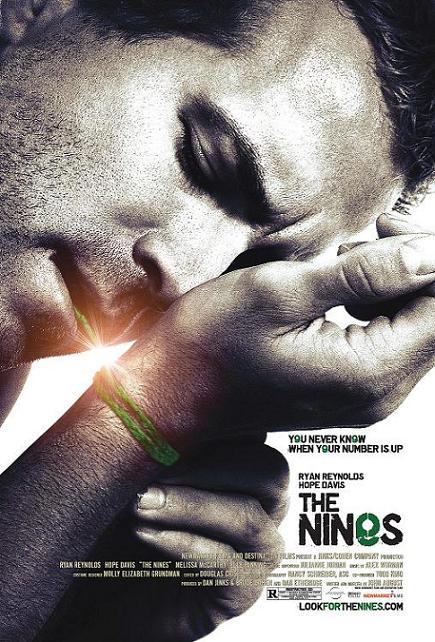
#40-The Nines (2007)


The Nines

Previously known for his writing collaborations with Tim Burton on films like Big Fish, the Charlie and the Chocolate Factory remake, and Corpse Bride, John August takes his first step into the director’s chair with The Nines. A psychological thriller comprised of three short films, all of which star the same actors as different characters, with often overlapping stories. It brings up challenging questions about author and character, actor and role, creator and creation and is like a riddle in that the question is the answer: “How does it all add up?”


The film has three principal actors, all playing three different characters as the film progresses: Ryan Reynolds plays Gary, Gavin, and Gabriel, Melissa McCarthy plays Margret, a fictionalized version of herself named Melissa, and Mary, while Hope Davis stars as Sarah, Susan and Sierra.


Gary is a troubled actor living under house-arrest in someone else’s home, who is described as “a TV writer away on work.” While there he only befriends two people, his P.R. assistant Margret, and his neighbor Sarah. As he spends his time in the house he sees different versions of himself in the building, as well as finding the number nine in everything he does. People leave the writer telephone messages about “looking for the nines” while playing backgammon, he continually rolls only nines, and even the baby monitor left by Sarah speaks of the nines during the late of night.


Gavin, the second character portrayed by Reynolds is the writer spoken about above, who is currently trying to get a new television show off the ground and into the hands of a studio. Meanwhile he recruits Melissa to play the lead actress, and is assisted by studio executive Susan. The third and final set of characters is the creation of Gavin, as we watch his TV show. Father Gabriel takes his wife Mary and their child to the canyon for a weekend getaway, but after the car battery dies Gabriel is sent to look for help, which may or may not come in the form of Sierra. Sierra is both a blessing and a curse as she continually drugs Gabriel, but also cryptically tires to convince him to “come back to reality.”


The performances by all three here are stellar. Reynolds, McCarthy and Davis all have the keen ability to play different characters all at once, and give each one of them their own personality and persona, and quickly and smoothly transition between multiple creations in the same scene. However the showstopper comes in the form of Melissa McCarthy who easily steals the spotlight when she enters frame. All of her characters are fun and sweet, and bring an emotional sense of gravity and humor to an otherwise dark film.


Though it was released by an independent studio, and had a rather small budget, the film has great production values. From a technical standpoint the film looks great. It was shot on video rather than on film and uses the limited color pallet to perfection, and computer color correction capabilities to its advantage. The first film looks really sharp and crisp, while the second looks grainy and washed out, and the third with a light tint of grey that covers each shot. The score by Alex Wurman enhances the films dreamlike quality, and it has a rollicking soundtrack guaranteed to perk the ears of viewer. Editor Douglas Crise uses the films non-linear story structure to his advantage, with editing that keeps things lively and cool, the same can be said for cinematographer Nancy Schreiber who uses the camera as a quirky way of communicating ideas and emotions to the viewer, without beating us over the head with unnecessary amounts information.


What’s most important about The Nines is its story. John August has crafted is smart, witty, and fresh creation. His dialogue is snappy, fun, and quick, full of references and little anecdotes that make it sound very real. His use of non-traditional narrative structure keeps the pacing of the film lively and never does it slow down. However, the film ends on a rather odd note, and though it gives us hints and clues along the way that allow us to piece together what is going to happen, what is happening, or what has happened (depending on your perception of the film), you’re never quite sure how it will all connect together. By the end of it you learn that the film has it’s own strange theology about the world, and questions the morality of humans, and if we can indeed transcend to become higher beings or if we are forever forced to be in a traditional human form. The ending is guaranteed to divide audiences, some are going to just say “What?” and feel cheated, and others will embrace it as a sign of the modern age, and the pain that sometimes come with it, I fall into the latter category and feel that the film is perfectly tuned into it’s audience and time period. While John August certainly is an excellent screen-writer, he defiantly shows even more potential behind the camera, and I can’t wait to see what he does next.

I Give The Nines A:
4.5/5

Saturday, October 16, 2010

#39-Martyrs (2008)

Martyrs
Recently within French cinema, there has been a new-wave of releses. These being incredibly violent, disgusting, and brutal, but also being loved by the public. This French new-wave horror cinema is trying to be remade in America, and appears to be having a similair effect to what happened with Asian horror films in 2002 when The Ring was realesed. Martyrs is one of the these films. It is sick, depraived, disgusting, brutal, violent, and unrelenting, but it is also when of the best horror films of the past decade.

Even before they begin production on a remake they must know that it is a terrible idea. The first and foremost is that the only reason for ever remaking things is to make more money on a new audience, but people who want to watch a film like Martyrs will seek it out and watch it, regardless of it being a foreign film. The second being the level of violence that is depicted in the film, which is incredible. It wouldn't appeal to a mainstream American audeince. Whereas films like Saw have violence shot in a stylized manner, Martyrs drops you in the middle of the violence and tells you to deal with it's brutality. Thirdly is the idea to cast Kristen Stewart. She's not a good actress! Who cares if she's popular and will draw people. No. Just no.

Martyrs tells the story of Anna and Lucie, two girls who have been friends since they met in an orphanage as young children. Lucie had escaped from an abusive group of scientists who ran violent experiments on many other small kids. Lucie is repeatedly attacked by a monster that has followed her since her escape. Flashforward fifteen years, and Lucie has broken into the house of a fancy family with a shotgun, and taken care of all four of them. She calls Anna for help removing the bodies. Turns one of them is still alive and is holding a secret in her basement. Lucie goes crazy and kills her, but not before discovering the family is running similair tests on a hostage in the basement to the ones Lucie went through as a child.

Writer/director Pascal Laugier has created something deeply effecting in this piece of cinema. Whether or not that is a positive or a negative I've yet to decide, as I hope to watch it again soon. In his recorded introduction to the film, he states that some days he thinks that this film is a true masterpiece, and others he wishes he had never made it in the first place. Both of these may be true. But, what cannot be denied is Laugier's excellent direction. The man can direct, and he can direct well. He has a keen ability to make his shots hyper-stylized, but not make them annoying. Similair to what I said about Peter Jackson in my Dead Alive review, he knows how to direct violence in a special way.

 Contrary to popular toture-porn horror films, which make you simply say "eww that's gross" Martyrs makes you feel it. Laugier's lens is unwavering. He knows what he is showing you, and he knows it is terrible and he just rests the camera on it until you just need to look away. When I was a bit younger (and still quite a bit today) I was an avid horror-film fan. I have seen some pretty messed-up things in my time, but rarely does violence in cinema make me uncomfortable. This proves to be an exception. There is one scene in particular -which I'll try my best not to completely ruin- that had me bringing my hands up over my eyes and peeking through the cracks of my fingers, only to see something even more vicious that I turned my head completely and just listened until the screaming stopped.  And while this may sound very dramatized it is what really happened, and when I think about the film I cannot get that sequence out of my head.


And whereas in my previous review of Deadgirl I complained about the senseless burtal violence as an ever imposing negative here it makes sense. There is a purpose to the violence that takes place within Marytrs. The payoff and explanation given for these brutal experiments that take place within the film created a conflict in me as a viewer. On one hand I  thought it was a kind of cool and interesting idea, something that had been done before, but was done different and in an interesting way to bring up so cool plot stings. However when the payoff finally did come and I realized what the movie was trying to say, I just kind of thought to myself "Oh, so that's where taking this". That was the only real flaw that I found with the movie, and it's only a sort of half-flaw. The only other one comes toward the end when they are showing the passing of time within the film. It's done in a series of really slow fade-in, fade-out shots. Normally I wouldn't mind this but the film had such a pace that when these really slow shots starting happening (and happening, and happening, and happening) it kind of drags the film down to this weird place of boredome where you just want something to happen.

The cast for he film is rather slim, only having about four or five main characters, and only having two of them on the screen for a good hour. Mylene Jampanoi who plays Lucie is incredible to watch onscreen.  She is this brutal and violent human being, but has this sort of sensitive outward appearance. You know that the reason she is crazy is because of the tests that were run on her as a child, but to sit and watch her commit acts of violence on others is something else. During the scene where she breaks into the house with a shotgun, as I described above, there is this really kind of soft and touching moment, where after killing the last person she just sits on the ground and rocks back and forth crying. It goes on for about twenty seconds, and the whole time there is just this aching within you that wants to reach out and give her a hug, even though she just massacred an entire family.

In the end, there is no denying that Martyrs is something powerful. Whether or not your morality will allow you to justify that is up to yourself. Sure it's shocking and violent and gruesome, but that isn't the films purpose. Unlike your Saws and Hostels where their violence becomes the main plot point, Martyrs doesn't. It has people that you care for, a story that you want to see through to the end and is just a well made movie. If you can stomach the brutality you will find that it is actually very poignant, sad and sweet. Lucie is one of my favorite troubled characters of recent memory. The movie in the middle is a character study, it is her story, about dealing with the trauma that she went through as a child, and about what she will have to deal with growing up. The violence is just layered around that as additions to the visceral experience. And when all is said and done it really drives you to connect with these people and watch them through to the end. So there. What is possibly one of the sickets films ever made and hype aside, I'd say it's amazing. I won't force you to see Martyrs. It's not a fun film to sit through, and it won't be to some people's taste. But for me and for what it is, Martyrs is near perfection.

I Give Martyrs A:
4/5