One of the hardest things about trying to give a theory on a film like Antichirst in particular, is how many interpertations of it can be made, and how after the reaction to the film, Lars von Trier doesn't appear to be giving out answers anytime soon. Another reason being is that it is a film of pyschological meltdown and confusion, giving any number of different possibilites for what is happening in reality. Combined with the films bizarre and surreal imagery and overall difficult tone, it is a hard film to pin to one certain message. I would also like to note that all this is written after a single viewing, and some serious note-taking. This post may change over time with additional viewings (if I dare.)
Being that the film is about a psycho-analysis of a woman by her husband, it must first be noted that some things may or may not be happening in reality. He and She are both deeply flawed people, and are emotionally unstable after the death of their son Nic. She expresses her sadness and anger through increasingly violent tendancies, and overall erratic behavior. But, nearly also as strange, is how easily He deals with it. He copes by trying to help She cope, almost never showing any emotional sign of the death of his son at all, except for a few tears at the beggining, which I'll get to later. The film also plays with the idea of Satan, Evil, and Human Nature, which all may have a metaphysical higher-power associated with them, and thus explaining some of the more outlandish, and impossible scenes the film depicts.
From the start, the film does have some overtly religious metaphorical connections. The cabin in the woods being called "Eden" and so forth. A scene towards the beggining, when He is helping She make a list of places She is afraid of, She mentions "the woods." He investigates further asking: "Any woods in particular?" Which is when we learn that She is scared of the woods around Eden, which He labels in parenthesis as (garden). Another play on the biblical tale of The Garden of Eden. Further religious themes come later in the film, such as when they are walking toward the cabin, and She claims that the ground is burning, and reveals burns on the bottom of her feet, as if Hell rested over that single patch of Earth. More details are added about this when She claims that "Nature is Satan's church", which allow us to make the assumption, of Eden being Hell. An interesting paradox and statement for the film to make. Even more religion inspired themes come in the form of She's earlier thesis paper, which is about the misogynistic treatment of women in the 1600's, for they were thought for witches, and the films title itself; Antichrist.
Though many paradoxes and connections can be made, and are obviously there, I am willing to write them all off. When She first speaks of Satan, He reacts with a mix of disgust and surprise. Allowing us to assume that She wasn't at all religious before the death of their son, and emotional break-downs. The two emotions, Disgust and Surprise allow us to say that 1) She wasn't religious and 2) He wasn't and still isn't. From here there are three possible ways for this to be taken.
1.He and She aren't religious, and therefore none of the impossible occurences can be attributed to a higher power.
2.He and She aren't religious, and are therefore being punished for their lack of faith by inserting the Antichrist into one of the characters.
3. He and She aren't religious, and are trying to be enlightened by a higher-power, but are unfourtanetly being swayed because they are standing over Hell.
However, I am going to say that the most likely answer is the first. None of the impossible occurences can be attributed to a higher-power. Cinemas depiction of religion usually comes in the form of religious characters, only religious characters exclaim to have any connection to God (unless the film is directly for religious purpose, at which point they will attempt to sway non-religious chatacters to their side). Since our characters are not religious, and all forms of religion on pushed on them by their own psychologic incapabilites, we can assume that they are not allowed to be effected by the Hand of God, or the Hand of Satan.
The film is notorious for its distictive look and unreal perceptions, many of which it has become famous for. The so called "Chaos Fox" and tree made with roots of human limbs and so forth. But what I think is interesting first and foremost are the animals. The first animal we encounter is a deer. The scene has He all by himself, after She has run-off, terrifed of the woods, when He finds a deer. First glance lets us know that this deer isn't like other deers. Usually when a deer meets with a human they dart into the nearest possible bush, or forested area (I live on the North-West coast of Oregon, the things are everywhere), but this deer just stands and stares at He. Not moving. Not Blinking. But aside from this the deer is pretty normal. Until it turns and we find that it has a stillborn fawn hanging out of its uterus. A possible, and in fact quite clear reference to the death of their child. In another scene where He is alone, a dead fox re-animates and begins to eat it's own entrails, and claims that "Chaos reigns". The third animal comes once more when He is alone, hiding from She in what appears to be a rabbit-hole, where a dead bird re-animates and begins cawing. This gives away where He is hiding and He kills it multiple times, only to have it re-animate and begin making noise again.
These all share a few things. Easily that they are all animals doing impossible things, which based on my theory above aren't really there. The deer isn't really there, the fox doesn't talk, the bird doesn't come back to life, they are all complete metaphoric symbols that have absoloutly nothing to do with the nature of the forest. However, another thing to notice is that all these animal occurences happen only with the character of He, and only when He is alone, without She in frame, for whatever the reason may be. The only animal scene that happens with She on screen is when a baby bird falls from it's nest dead, only to be swept up and eaten by a Raven, something that could very easily happen in real life. This is also something that I will touch on later.
Now the question. What do all these animals mean? The three beggars as they are so called. In the scene when He ventures into the attic to find She's scrawled thesis paper and crazy writing, She has carved into the desk a picture of the three beggars. The three-beggars have names carved into them as well, Grief, Pain, and Despair, which also share their names with the names of the chapters the film is broken up into. A pretty clear connection between what each one represent, and how, in the conclusion, where all three beggars must arrive before She will kill He, this means that all three emotions, Grief, Pain, and Despair, must arrive in the both of the characters, in their complete form, in their full, natural forms, untouched by their original oddities, before He or She dies.
Another connection I would like to make is when She has run out of the house and begins masturbating on the tree. The tree starts out normal, like a tree looks, it is only when He enters the scene that the tree seems to ascend from it's basic form, and grow these strange human limbs, which appear to be the limbs of the dead, possibly buried underneath. So now we have He as the only one who had the delusions of animals, and He as the one who seemingly caused the appearance of the dead bodies, thus insinuating that there is something definatly wrong with He.
Which isn't to say there isn't something definatly wrong with She. The film reveals to us, very breifly, and without much else said about it, that She had been putting Nic's shoes on his wrong feet. And She has been doing this for a significant amount of time. It also reveals to us that she might have done this purposfully, when Nic starts crying, and She does nothing. Similairly, Nic fell out of a window, just as the dead baby bird fell out of the nest, only to be consumed by a Raven later. Early on in the film, She explicitly states that He is not paying enough attention to She, and after the death of Nic, She gets literally all the attention from He, who then thinks he can cure her. Is it possible that she wanted Nic dead? To get the attention of He? That putting the shoes on the wrong feet was just the start of a very severe pyschological damage? I think that when the Raven eats its own child, it is a clear connection with She having wanted Nic dead.
Both characters are incredibly psychologically damaged, have little-to-no connection or sense of reality, and quite simply are insane. The final straw for She comes in the finale where She has conivinced herself that all women are evil (a very clear sign in biblical texts, which throughout the film she becomes increasingly attached to) and begins to genitally mutilate herself and He. An incredibly clear sign that she has lost it. Now is when they are both completed filled with the three 'beggar' emotions, and the three animals show up. Except something happens. Whereas She has had the power for the entire film, she has been the most violent, and from the beggining has been the sexual instigator, He takes control. He kills She by strangling her to death, and then burning her body of a fire. But the scene is quite odd. She, who is usually in control, puts up no struggle at all to stop He from killing. Possibly fufilling what she wanted all along 1) getting all the attention from He and 2) much later, thinking all women are evil, and therefore letting He kill her. The final insanity straw for He breaks after he has escaped the cabin, and is walking away. The ground next to him is completely filled, and piled up with dead bodies, something that couldn't really happen, and must be happening in his head. A clear sign of even more problems, and once he reaches the roll of the hill, an incredible amount of women start walking up. Just women, walking up the hill on their own accord, faces blurred, with no features.
Which brings me to my next point, the blurred faces of the thousands of women are seen elsewhere in the film. During the funeral scene for the young boy, all the followers of the hearse besides He and She have faces that are completely blurred out as well, with no features. This scene also has He crying what appear to be some really fake tears, and overly sensitive touching of the hearse. It all seemed very staged. Perhaps He also never wanted a child in the first place. She was always the sexual instigating. Is it possible that He never wanted a child in the first place, and as time grew neither did She?
I think the clear message of the film is that Satan is evil, as Nature is evil, as People are evil. That we are all following the same basic pattern of life and death, and though humanity might seem like a terrible thing, we are simple a mirror image of nature. The Deer suffers Grief. The Fox suffers Pain. The Crow suffers Despair. Just as He and She did. The dead bird fell from the tree, only to be consumed by its parents, just as Nic fell from the window. Falling acorns sound eerily simlair to bullets. Tree roots look eerily similair to arms. And thousands upon thousands of things die in nature everyday, just as thousands and thousands of people die everyday. But also nature overcomes everyday, just as humanity overcomes everyday. We are Nature, Nature is us. And if the film is trying to pin one thing inparticular as the 'Antichrist' it is nature. Not He. Not She. Characters who are equally flawed, but nature, who drove their insanity even further into the depths than it already was. If the film is anything more than a simple shocker its this. Make of it what you will. Am I right? Am I wrong? That's up for you to decide. You are free.
Showing posts with label Cult/Other. Show all posts
Showing posts with label Cult/Other. Show all posts
Wednesday, December 1, 2010

Sunday, November 28, 2010
#41-Antichrist (2009)

Antichrist
What is there to be said about Lars von Trier's Antichrist that hasn't already been said. A film so much about misogyny it might become misogynistic? A nasty little shocker designed to make us talk? A look at the emotional core of Pain, Despair, and Grief? Or simply a coping mechanism the director made for himself? Whatever the answer is up for each individual to decide for themselves, but all I can say about Antichrist is that it will certainly leave you thinking, and is more of an emotional test and experience than it is an actual film. Antichrist can go down in history as one of the few films that left me physically shaken.
The plot of Antichrist is actually somewhat simple when giving a synopsis. One day a husband and wife (credited only as He and She) are making love and not paying much attention. Their young toddler wakes up climbs out of his crib, and accidently falls out a window and kills himself. She blames herself and is in the hosptial for a month befor He -a therapist- decides to make her his own patient. They retreat to a cabin named Eden in the middle of the forest in a hope to escape. When He learns that She's biggest fear is nature and 'the woods' around Eden in general, he thinks best to stay in the situation that frightens her the most in hopes of overcoming her fear, which of course proves to be a fatal mistake.
Before we get into the complications of Antichrist what cannot be denied is the sheer quality of the filmmaking. Whether or not you agree with what von Trier put on the screen, it simply impossible to not be astounded by how beautiful these shocking images are. The opening shots, extreme slow-mo, high contrast, black-and-white are simply breathtaking, as are many shots in the film that have interesting effects applied to them. The direction, as per usual, is pitch perfect in general. Von Trier has always been great with actors and actresses, getting them to do things on screen they usually wouldn't, and this is no exception. Willem Dafoe and Charlotte Gainsbourg (as He and She respectively) give the performances of a lifetime, bearing it all, and easily putting their careers on the line, to give top-notch performances. This especially applies to Gainsbourg who has to do some of the most terrible things you could ever ask an actress to do, does them with great conviction and flare.
Another aspect to be complimented is how absoloutly creepy, and unsettling the whole experience is. The lighting and sound design reminded me of some of David Lynch's latest work, most notably Inland Empire. The sound design is eerie, and creepy, and just makes you squirm in your seat, while the lighting is some of the most horrifying, and yet beautiful, at casting and playing with shadows. Add in the nature aspect, lots of fog and mist, and you get a shot of tree with shadows rolling on the branches, with the simplest music, and it makes a single scene that is scarier than most modern horror films can claim to be in their entirety.
 |
| "The three beggars aren't here." |
However, there is the part of Antichrist is that is the only thing that most people the care about. The shocking, brutal, realistic, graphic sex and violence. While I won't go into any detail about the violence just know, as someone who is totally comfortable with violence in cinema, and someone who can easily sit through the Saw films, and the Hostel films, Antichrist just plain made me uncomfortable. It is notorious for two scenes in particular, and even knowing what was coming I still was incredibly shaken after watching them. Now for me this is both good and bad. While I can't applaud von Trier for putting these things on screen, I can applaud him for not letting the MPAA have a say in his work. He made the film he wanted to make, and the film stays unrated for good reason. It would easily have gotten, and maybe even surpassed (if they do that) an NC-17 rating.
But, this is also where the film falls apart. The scenes are brutal and disgusting and graphic, so much so that it actually draws you out of the film a little. The same can be said for the sex, which for awhile seemed like von Trier just giving the finger to the film industry standards, but in the end just becomes gratuitous and boring. It felt very reminiscent of -again- David Lynch's film about psycho-sexual awakening Blue Velvet, which had not nearly as graphic sex, but still enough to make it almost annoying. My theory as to the actual purpose of the film Antichrist is this: It seems like von Trier wanted to put us in an emotional place where we hadn't been before. A place that made us incredibly emotionally uncomfortable, and then wanted us to stay there and think about it. So it seems to me, had came up with a few scenes that would put us in that place, and then he built a film around them. And as such, so many scenes have so much more emotional impact than the others that the film feels very uneven, and sometimes rather clunky. To try and give the film meaning, and therefore justify what he did, (and maybe even cover himself a little) he then threw in the surreal images, the hard to find messages, and confusing imagery, which would make it appear to be more than it really was. A nasty little shocker, that was designed to put us in a place where we would feel uncomfortable, and makes us talk.
In the end, I think thats all that Antichrist really is. Does the film have a message that is hidden somewhere deep within the confusing imagery and surrounded by chaotic violence? Maybe it does, maybe it does speak some truth about Grief, Despair, and Pain, but I don't think that was Lars von Trier's goal in the long run. He wanted see how far he could push the human psyche, and he wants people to talk about it. That being said, I cannot say what he did is truly justifiable in anyway, because it doesn't need to be justified. Do the Saw films need to justifiy themselves for what they do? No, because they are designed to do what they do, and I think Antichrist is too. The surreal imagery, and the attachment of Lars von Trier's name make us think that it is something more than it is, and I think von Trier did this on purpose, but it doesn't mean anything. It's there to make you think that it has some meaning. However, of all the nastly little shockers I've seen (and there have been plenty) Antichrist is easily the best. The superb performances from two great actors, and perfect direction of some of the most disgusting scenes ever put to the screen make it incredibly hard to watch, as it should be. The cinematography, lighting, and sound design make it one of the scariest movies in recent memory, and of all time and therefore I do think Antichrist suceeds. If at nothing more, than being a good scary movie.
I Give Antichrist A:
3/5
Friday, April 23, 2010
#23-Inland Empire (2006)
 Inland Empire
In speaking about Inland Empire, we must speak about it’s complications. The first and foremost being that this film is from David Lynch. Lynch is the creator of the 90’s cult television show Twin Peaks, as well as having three pervious Oscar nominations under his belt. Now, do not let all these impressive accolades fool you, David Lynch is not your typical fancy, high-end drama director, not someone willing to feed you the answers, just so you understand the question. Quite the opposite in fact. David Lynch hates people knowing the answer, or his answer to be precise, often when people ask him about the meanings to his work, his answer is ‘whatever you want them to be.’. Now, having stated this, if you haven’t seen a David Lynch film, do not start with Inland Empire, while this may seem like a negative, it is not. The reason I tell you not to start with this film, is because it is his least accessible, and his most impressive, being that it has no direct, or cohesive narrative. If you would like to watch a Lynch picture, start of with Wild At Heart, The Elephant Man, or The Straight Story, then work your way into Blue Velvet, or Eraserhead, after watching these, you can then fully delve into Lynch’s most luscious works, that include the likes of Lost Highway, Mulholland Dr., and last but not least, Inland Empire.
With no real plot to follow, it is rather hard to explain what goes on. For the first hour or so, the film is rather easy to understand, and a little mystery starts and everything is fine until we reach the two hour mark, then everything just gets weirder, and weirder, until we’ve fully descended into the rabbit hole, but I will try my best. The film opens with a prostitute being led into a dimly lit hotel room, asking the man what is going on, the film fades out, and into another room, this time with proper lighting, but without proper inhabitants. We find three rabbits sitting in a 1950’s art deco house, as if they were on their own sitcom, which it seems they are, with canned laughter coming from an unseen audience whenever one of these strange rabbits speaks. Back in the dusty hotel room, the woman is now crying, sitting on the edge of the bed, watching the television, where we see a strange red-headed woman walking down the sidewalk, we slowly zoom into the TV and watch this woman walk all the way to the home of Nikki Grace, the films main character, all within fifteen minutes.
Nikki Grace (Laura Dern) is a film actress, who hasn’t had a successful part in the last few years. This opportunity shifts after she auditions for a role in a promising new film. Upon receiving the part (prophesized by the strange red-head, who unfortunately also prophesized murder) Nikki starts to get into her character of Sue Blue. Her director (Jeremy Irons) begins to tell everyone on set to get ready, because this film will launch them to the top of everyone’s year end list. This is until things go a little awry. Okay, a lot awry. Nikki begins having a real affair with her characters secret onscreen lover (Justin Theroux), they are also told that the film is a remake of an unfinished Polish film, in which all the films creators had died under mysterious consequences. All this while Nikki begins to lose herself in Sue. Not only is this hard for Nikki, but us as well, because David Lynch never tells us when she is acting as Sue, or when it is real life as Nikki, he does this purposefully. Before we know it, Sue is Nikki, Nikki is Sue, and we have no clue what is fantasy and what is reality, nor do we know if Nikki knows what is fantasy and reality. The film is even harder to understand with it’s three hour running length, and darkly creepy elements.
This, in my opinion, quite simply stated, is David Lynch’s magnum opus. It is filled to the brim with metaphors to the film industry which he has been in for years, and never does it slow down. He creates a fantasy within our own reality, making everything that happens seem oddly logical. He makes this woman, who is in dire trouble, someone to sympathize with, a temporary friend that we hold dear, even if we don’t truly know who she is. Lynch does impossibilities so well, we forget that he is going against everything we know; which is perfect. A director of that has this much power is defiantly a force to be reckoned with. There are very few three hour films that I am willing to sit through multiple times, even three hour films that I enjoy (Dark Knight, Magnolia), but Inland Empire is the exception. It isn’t necessarily because I notice something new in the film every time, but because I notice something different from the same thing. I’ve seen the film three times, the first time I walked out deeply confused and with an odd sense of loss in the pit of my stomach, the second time I walked out understanding more of the films theme, but a little depressed, the third time I walked out overjoyed, and very happy, feeling that the I’ve overcome something. I think this idea of changing emotions will be everyone’s experience, assuming they are willing to sit through the film multiple time, which you basically have to, or you’ll just walk out feeling like you’ve missed something.

"Come on baby, do the locomotion"
Not that I am a fan of the Academy Awards, or there picks, much less there wins, I still find it incredibly hard to believe that Laura Dern did not receive a nomination, at least. She has such (a) defined character(s), and pulls it off masterfully. An actress playing an actress playing a character has got to be one of the hardest roles in film history, because you first have to step outside yourself, and act like you are being yourself (one of the hardest things to do in real life), then you have to step outside of that and acting like you’re acting. Not to mention she is playing a character who doesn’t know if she is herself or a character, basically playing both at the same time. By the end of the film I counted Laura Dern playing six different people, or people within the minds of people and this number could be more, could be less. She is able to give each character their own persona and abilities, and is able to get into the mentality of each one, often switching between them each scene, which is an accomplishment in it of itself
This may seem very confusing, and it is. David Lynch gave the film so many literal layers that you have to pick one and stick with it. By the end of the film, you feel as though you’ve completed that specific quest, and next time you will be able to fulfill another, until you’ve connected all the plot strings to get a -hopefully- entire film in your head.
I must applaud Lynch’s writing on this one. Because not because of dialogue, or a specific plot point, but because he wrote each scene the day before shooting. It was originally going to be a set of short films, but eventually grew, and grew as he saw the full extent of Dern’s talent and where the story could go, until finally we have a three hour epic known as Inland Empire. A film that took an abnormally long three years to produce, and compelling all the way through. The direction by Lynch is also amazing as well. He, for whatever reason, knows how to use sound perfectly, or I suppose lack there of. He can completely go without any background noise, or dialogue, and make some of the creepiest scenes in film history. His idea that film is like music greatly shows in all his works. Lynch’s films aren’t about telling a specific story, or sending a certain message, but rather making us feel something. You can break down some of the scariest scenes in Inland Empire (which there are a lot of, even though it is a clear drama), and not find out why you are scared by them. One scene in particular with Dern running down a dirt road in slow motion gives me the chills every time. The picture is also shot completely with digital video, and uses that color pallet to perfection, making every color seem slightly grainy, and washed out, adding to the films dreamlike qualities.
Inland Empire will not be everyone’s cup of tea, in fact, I fear that it will appeal to a very small audience. This being said, that core group of fans will never look at cinema the same again. David Lynch has created something else here, something can induces and displays an amazing range of emotion, and has a certain feeling that floats around the film like a bubble, capturing the audience, an audience that may not understand, or even like what they are watching, but will feel what they are watching. Inland Empire is a film that you have to be ready to watch, one you have to be in the right mind-set for, and one that you want to except, no matter how weird or confusing it gets, you must accept what it is, it is then that you will truly find what lies in the middle of the Empire. Inland Empire is two hours and forty-five minutes of crawling through a dark, depressing, evil, and claustrophobic tunnel, to get fifteen minutes of some of the happiest cinema in history. Inland Empire is one of the best films of the year, the decade, the century, and, of all time.
I Give Inland Empire A:
5/5
Monday, March 29, 2010
#21-Brazil (1985)
 Brazil
To even begin with the film of Brazil, you need to know what happened behind the scenes. Much of which is still reported on as one of Hollywood's biggest calamities. The film was written and directed by former Monty Python animator Terry Gilliam. Gilliam's fantasy was bleak, dystopian, and very distant from what modern American's had recently seen in fantasy, with films like Alien. In Europe, Brazil had a running length of 142 minutes, where it was met with critical and commericial success. A major battle between the films creators, and the American distributor cut out major portions of the film, cutting it down significantly to 94 minutes. Gilliam feriously protested this, and without the consent of the studio showed the film to the Los Angeles Film Critics Association, where it won Best Picture, which then prompted the distributor to meet with Gilliam halfway, realesing a 131 minute version, which still performed poorly at the US box-office.
Much like the controversy behind the film, what happens in front of the camera is hard to follow, and understand. In a fictionalized version of Britain, Johnathan Pryce plays a man by the name of Sam Lowry, a low-ranking government official. Strangley enough, Sam constantly has fantasy daydreams of rescuing a damsal in distress. Sam is sent to to rectify a mistake, the governement accidently captured, and killed a man by the name of Harry Buttle, instead of suspected terrorist Harry Tuttle. When arriving at their home, Sam finds that a woman in the second floor, is an exact replica of the woman he has been dreaming about. Through a series of incidents, Sam meets up with both the mysterious woman, and the real Harry Tuttle, and soon becomes a wanted terrorist himself, and has to deal with this, his love life, and his plastic surgery addicted mother, all while trying to fix his air conditioning.
While it may sound like a comedy of errors, Brazil has got to be the best social, and political satire film, since Dr. Stranglove. Terry Gilliam has woven a very intense story here, and it certainly shows. While the film is largly a visual fantasy, and even some story elements are taken from classic fantasy story, the film is actually largly grounded in reality. Nothing seems to be going right for this character, even though he is just a low-ranking official. The film also delves into political satire, on both sides of the pond, with the film being based out of England, and largly poking fun at parliment. But also noting the failures of America's current political system. The film has a strangly modern feeling to it, even watching it now, with major sub-plots dealing with terrorist bombings, drug addiction, and plastic surgery.

"Here's your recepit for your husband, and my recepit for your recepit."
Now, the verison of the film that I saw, was the original 142 minute directors cut. Now, I am not saying that this film is just dark and bleak for fantasy, it truly is dark, and bleak, and even somewhat depressing by the end, especially what it has to say about the current human. Terry Gilliam is excellent at fantasy but what he does even better is reality. And that is where Brazil succeeds for the most part. This is one of the best films I have seen this year. The top three from my first twenty-one reviews definatly include Brazil. And while I did like it a lot, the film does come with a few minor problems, but first with the positives. Johnathan Pryce gives a stellar performance as Sam, and was very good at what the role was. A man, with too much to handle, and tons of stress, slowly unwraveling is a lot harder to do than most would think. Roberto De Niro does a great job in a realtivly small role, not really that small, but for a movie of this length. It is a bit of a switch from the regular De Niro, and a nice switch indeed. One of the best performances though comes from Kathrine Helmond, who plays Sam's insane mother, addicted to plastic surgery and fashion, she provides much of the humor of the film, and much of the satire, which goes hand-in-hand all to well.
One of my minor nit-picks with the film comes from its length, running two hours and twenty-four minutes long does seem to show at some points, and there are many times when I thought: 'oh, I guess that's the end', and it just kept on running. It never seemed to end (though it makes sense now why), but it was sometimes, hard to pay attention. This is not helped by the fact that the story is very, very thick, with lots of characters, and names, and times, and people, and things, and sub-plots all revolving around one person, making the whole thing seem very crowded, this is deeped, again with the Tuttle/Buttle mix-up, that the viewer constantly has to sort out mentally.
Amazingly though, Brazil is still an excellent film. Faults like those usually ruin a movie for me, but Brazil had a strange dreamlike effect on me, and was a thrill to watch. The film has meaning, and passion, and thought, and people we can relate to, all while surrouding itself in an incredible visual package that makes it a pleasure to sit through. Things like convuluted story, and running length seem like small complaints when you look at the picture as a whole. Terry Gilliam has created something special here, and I hope he comes back to dramas, and satires similair to this film. The cast, direction, and writing are all great. Topped off with excellent costumes, sets, cineamatography, lighting, and score. Brazil, is truly, a film to behold.
I Give Brazil A:
4.5/5
Friday, February 12, 2010
#14-Mulholland Dr. (2001)
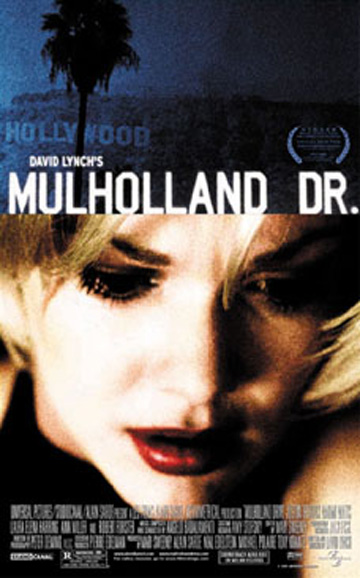
Mulholland Dr.
 "Blue box, blue key."
David Lynch, who is one of the top film-makers of this generation, in my opinion, brings us a startling dive into the mind of four people. Our is it two? Or three? These are the kinds of questions Mulholland Dr. raises, in it's attempts to slowly rot away at your mind.The film was originally set to be a television show on ABC, but was canceled after a failed pilot episode. While I don't think that Mulholland would have been as good strectched out, I do think Lynch could have pulled it off, hell, just look at Twin Peaks. One of the strangest shows on television, with enough weird concepts to put even the most artsy people off, and Twin Peaks remains one of the best remembered shows of the 90's.
Now, I'm warning you, if you are a typical moviegoer, you are not going to enjoy this movie. I hate having to give out warnings like this, because the films are so excellent, but you know that some people just won't like them. Even if you aren't a typical moviegoer, don't watch this until you are ready. There are some movies that you just have to be in the right mind-set for, and no matter how much you've prepared yourself, you are never fully ready for a Lynch film. Many people consider this his best, but I do think that he has one better film out, which I will be reviewing soon to come.
It's almost impossinble to explain Mulholland Dr. without giving away essential plot points, but, I can try. We have a young woman from Canada, who is moving down to Hollywood, California to become an actress. Her aunt is out of town, and she is able to stay at her place. But, upon entering her condo, Bette finds a woman, who has recently been in car crash, and lost her memory has been hiding inside. So, while trying to get a role, Bette decides to help this woman find her memory, along the way they encounter many strange people and things, that you won't believe, even after you see.
First off, let me say that this is David Lynch's most accesible movie, and the easiest to understand. That having been said, you will not understand this movie. I've seen it five times, and still have not come up with an explanation for everything. One thing that I always praise about Lynch films, is how he uses pretty unknown actors and actresses, but they all perform very well. Naomi Watts, gives what is probably her best performance ever, which is very tricky, especially given the role she has to play. Laura Harring also gives a very riviting performance, as a woman with so much character, who may be just that. The film has a wide variety of stange creatues that make up the supporting cast, including: Justin Theroux, Ann Miller, Dan Hedaya, and many others, all of whom perform exactly as they should.
Now, I'm warning you, if you are a typical moviegoer, you are not going to enjoy this movie. I hate having to give out warnings like this, because the films are so excellent, but you know that some people just won't like them. Even if you aren't a typical moviegoer, don't watch this until you are ready. There are some movies that you just have to be in the right mind-set for, and no matter how much you've prepared yourself, you are never fully ready for a Lynch film. Many people consider this his best, but I do think that he has one better film out, which I will be reviewing soon to come.
It's almost impossinble to explain Mulholland Dr. without giving away essential plot points, but, I can try. We have a young woman from Canada, who is moving down to Hollywood, California to become an actress. Her aunt is out of town, and she is able to stay at her place. But, upon entering her condo, Bette finds a woman, who has recently been in car crash, and lost her memory has been hiding inside. So, while trying to get a role, Bette decides to help this woman find her memory, along the way they encounter many strange people and things, that you won't believe, even after you see.
First off, let me say that this is David Lynch's most accesible movie, and the easiest to understand. That having been said, you will not understand this movie. I've seen it five times, and still have not come up with an explanation for everything. One thing that I always praise about Lynch films, is how he uses pretty unknown actors and actresses, but they all perform very well. Naomi Watts, gives what is probably her best performance ever, which is very tricky, especially given the role she has to play. Laura Harring also gives a very riviting performance, as a woman with so much character, who may be just that. The film has a wide variety of stange creatues that make up the supporting cast, including: Justin Theroux, Ann Miller, Dan Hedaya, and many others, all of whom perform exactly as they should.
"Blue box, blue key."One of the reasons I always love Lynch films, is they purposley give the middle finger to traditional narrative. Never will you find a film of his that is normal in anyway. With maybe the exception of The Elephant Man, but we'll let that one slide. I love films like this, for the same reason I love films with open endings. Because it leaves them open for interpertation, and that allows you to make them the movie you want them to be, thus hightening the experience a great deal.
The main story, which was explained above, is simple enough, and could have been turned into a nice, mystery thriller in the hands of another writer/director. But Lynch throws all sense out the window in the first act, puts a bag over your head, and spins you around and around, until you don't know where you are. This is another reason why I love Lynch, his films, at the heart, are all realtivly simple, and easy-going, but with a few sleight's of hand, he turns them into a complete fantasy land, turning everything on it's ear, and telling you it's the toe. His direction is simply fantastic, and his writing superb. While a few of his previous films weren't so good, all are aloud forgiveness, with Mulholland Dr. alone. Lynch alone made this movie worth seeing, backed up by excellent acting, marvelous attention to detail in production, and a great lighting department, Mulholland Dr. is propelled to the front of the pack.
The final thing I would like to comment on, before I finally wrap-up this review, is that I think Lynch should create a funhouse. Not a scary carnival funhouse, but a surrealistic walk-through ride of imagination. One of his best film attributes, is his ability to take sounds and images, and make them what they are not. There are moments in Mulholland Dr. that are some of the scariest I have ever witnessed, and if I were to dissect the scene, and break it down, I would have no clue why they would be scary. He also knows how to use lack of sound to create some very startling effects. One thing that he does perfectly to create tension, is if a camera is running down a long hallway, he makes it one continous shot. One, long, seemingly never-ending shot, which about midway through, loses sound completely, even when whatever jumps out from behind the wall, there is no sound, which makes even more terrifying.
The main story, which was explained above, is simple enough, and could have been turned into a nice, mystery thriller in the hands of another writer/director. But Lynch throws all sense out the window in the first act, puts a bag over your head, and spins you around and around, until you don't know where you are. This is another reason why I love Lynch, his films, at the heart, are all realtivly simple, and easy-going, but with a few sleight's of hand, he turns them into a complete fantasy land, turning everything on it's ear, and telling you it's the toe. His direction is simply fantastic, and his writing superb. While a few of his previous films weren't so good, all are aloud forgiveness, with Mulholland Dr. alone. Lynch alone made this movie worth seeing, backed up by excellent acting, marvelous attention to detail in production, and a great lighting department, Mulholland Dr. is propelled to the front of the pack.
The final thing I would like to comment on, before I finally wrap-up this review, is that I think Lynch should create a funhouse. Not a scary carnival funhouse, but a surrealistic walk-through ride of imagination. One of his best film attributes, is his ability to take sounds and images, and make them what they are not. There are moments in Mulholland Dr. that are some of the scariest I have ever witnessed, and if I were to dissect the scene, and break it down, I would have no clue why they would be scary. He also knows how to use lack of sound to create some very startling effects. One thing that he does perfectly to create tension, is if a camera is running down a long hallway, he makes it one continous shot. One, long, seemingly never-ending shot, which about midway through, loses sound completely, even when whatever jumps out from behind the wall, there is no sound, which makes even more terrifying.
As if you couldn't tell already, Mulholland Dr. is an excellent film. David Lynch (can't say his name enough) has created an amazing realm of peril and chaos, that only he could. I'd like to take a note from Michael Phillips who said "About half-way through, you'll have lost all your bearings, but in a good way, and you certainly won't mind." That about sums up the film, it makes sense, truly, it does. But you won't ever be able to figure out where all the loose ends tie up. Excellent writing, directing, imagery, sound, lighting, music, editing, set design, costumes, make-up, and much, much more definatly make this a film to see.
I Give Mulholland Dr. A:
5/5
5/5
Subscribe to:
Posts (Atom)
