Showing posts with label Drama. Show all posts

Tuesday, December 7, 2010

#43-Breaking Upwards (2009)

Breaking Upwards

Breaking Upwards, now my favorite film of the Mumblecore movement is also one of the most true to the definition. The film, about the hardships of relationships on twentysomethings these days, takes a really tired and cliched plot and makes rather interesting, and what makes it so, is knowing that what actually goes on did really happen. The story is taken from a true experience between stars Daryl Wein and Zoe Lister-Jones, about their breakup, and what they tried to do to come back together.

The story happened between star, co-writer, director, co-producer and editor Daryl Wein, and star, co-writer, co-producer Zoe Jones who found their relationship in a bit of a slump. To try and jump start things again they decide to take "off days" where they only see each other four days a week, and are not allowed to speak to or see each other the other three. They then change the rules to allow the relationship to be open on off-days, and often encourage each other to ask out other people. An interesting idea, but as you watch the the film you realize that it does have some pretty obvious negatives, but some really great positives.

Firstly, because it is based on a true story, and has the actors playing themselves, this all feels like it could really happen in your town, with people you know. There are great little touches and things that add to the authenticity, such as whenever they meet when biking they 'helmet bump' which you see in the trailer. When they first decide to have an open relationship Daryl asks: 'what should I change my facebook status too?' And its all things that really do happen, such as an early scene where they are both eating breakfast together, but are texting different people at the same time. It is an incredibly, and almost painfully, honest look at the way modern society has effected realationships, both for better and worse.

Both Daryl and Zoe give incredibly strong performances (granted as themselves) and because they really did have a realtionship, there is some incredible chemistry there. The film is boasted by some impressive minor characters played by the great Andrea Martin, Julie White, and Olivia Thrilby. Some of the lines that come out during Zoe and Daryl's fights are really kind of heartbreaking because they say things that make sense. Things that people do often feel in realtionships, and things that we face everyday.

The films only problem comes toward the end, when the climax happens. It walks a very fine line between being really, really honestly sad, and just cliched and theatrical. But I think the way its played out leans it toward the former, and allows what happens to make sense, even though the story may have been embellished a little for the screen. Shot on digital video, the most popular format for independent cinema, it looks really good with all its imperfections. For films like this and other independent cinema, I really dig the shakey, handheld, unpolished filming style, it gives everything that happens a sense that its grounded in reality, and that based on these characters actions the plot unfolds, instead of having the plot forced on the characters. Another great aspect is the soundtrack composed by Kyle Forester. Its got hipster tunes that are just hipster enough that feel cool listening to them, but not so much that you feel you're being ironic. I know it sounds weird but its very true, the film has a great soundtrack, with all the songs having been written by Zoe as production went along.

I may be impartial to this film because it depicts the era of realtionships that I grew up, and am still growing up in. I never got a chance to experience things that happen in the great romances of the 30's. That way of life is just foreign to me, and I don't understand how it worked without being able to IM people or send them texts all the time, and I think that breaking upwards makes a good point, that our connections to people have been lessened because of all these diffrerent forms of media we are allowed to communicate to them through 24/7. Making real-life interaction seem less imporant than it was back then, and really is still today

If you can't tell by now, I just loved this film to death. Its honest, and thats the best thing about it. While cinema is mostly escapism sometimes it is just good to see the truth on screen and realize that other people do go through the same thing you do, and people that are in movies. Great writing, excellent direction, solid performances, and a great score make this something that really is to be experienced. It's not easy to find on DVD or in theatres, but it is avalible to watch on Netflix's instant service, and if you subscribe to Netflix this is definatly one to check watch, and if you don't I highly, highly, recommend that you seek this out.

I Give Breaking Upwards A:
5/5

Wednesday, December 1, 2010

Antichrist: A Theory and Analysis

One of the hardest things about trying to give a theory on a film like Antichirst in particular, is how many interpertations of it can be made, and how after the reaction to the film, Lars von Trier doesn't appear to be giving out answers anytime soon. Another reason being is that it is a film of pyschological meltdown and confusion, giving any number of different possibilites for what is happening in reality. Combined with the films bizarre and surreal imagery and overall difficult tone, it is a hard film to pin to one certain message. I would also like to note that all this is written after a single viewing, and some serious note-taking. This post may change over time with additional viewings (if I dare.)

Being that the film is about a psycho-analysis of a woman by her husband, it must first be noted that some things may or may not be happening in reality. He and She are both deeply flawed people, and are emotionally unstable after the death of their son Nic. She expresses her sadness and anger through increasingly violent tendancies, and overall erratic behavior. But, nearly also as strange, is how easily He deals with it. He copes by trying to help She cope, almost never showing any emotional sign of the death of his son at all, except for a few tears at the beggining, which I'll get to later. The film also plays with the idea of Satan, Evil, and Human Nature, which all may have a metaphysical higher-power associated with them, and thus explaining some of the more outlandish, and impossible scenes the film depicts.

From the start, the film does have some overtly religious metaphorical connections. The cabin in the woods being called "Eden" and so forth. A scene towards the beggining, when He is helping She make a list of places She is afraid of, She mentions "the woods." He investigates further asking: "Any woods in particular?" Which is when we learn that She is scared of the woods around Eden, which He labels in parenthesis as (garden). Another play on the biblical tale of The Garden of Eden. Further religious themes come later in the film, such as when they are walking toward the cabin, and She claims that the ground is burning, and reveals burns on the bottom of her feet, as if Hell rested over that single patch of Earth. More details are added about this when She claims that "Nature is Satan's church", which allow us to make the assumption, of Eden being Hell. An interesting paradox and statement for the film to make. Even more religion inspired themes come in the form of She's earlier thesis paper, which is about the misogynistic treatment of women in the 1600's, for they were thought for witches, and the films title itself; Antichrist.

Though many paradoxes and connections can be made, and are obviously there, I am willing to write them all off. When She first speaks of Satan, He reacts with a mix of disgust and surprise. Allowing us to assume that She wasn't at all religious before the death of their son, and emotional break-downs. The two emotions, Disgust and Surprise allow us to say that 1) She wasn't religious and 2) He wasn't and still isn't. From here there are three possible ways for this to be taken.

1.He and She aren't religious, and therefore none of the impossible occurences can be attributed to a higher power.

2.He and She aren't religious, and are therefore being punished for their lack of faith by inserting the Antichrist into one of the characters.

3. He and She aren't religious, and are trying to be enlightened by a higher-power, but are unfourtanetly being swayed because they are standing over Hell.

However, I am going to say that the most likely answer is the first. None of the impossible occurences can be attributed to a higher-power. Cinemas depiction of religion usually comes in the form of religious characters, only religious characters exclaim to have any connection to God (unless the film is directly for religious purpose, at which point they will attempt to sway non-religious chatacters to their side). Since our characters are not religious, and all forms of religion on pushed on them by their own psychologic incapabilites, we can assume that they are not allowed to be effected by the Hand of God, or the Hand of Satan.

The film is notorious for its distictive look and unreal perceptions, many of which it has become famous for. The so called "Chaos Fox" and tree made with roots of human limbs and so forth. But what I think is interesting first and foremost are the animals. The first animal we encounter is a deer. The scene has He all by himself, after She has run-off, terrifed of the woods, when He finds a deer. First glance lets us know that this deer isn't like other deers. Usually when a deer meets with a human they dart into the nearest possible bush, or forested area (I live on the North-West coast of Oregon, the things are everywhere), but this deer just stands and stares at He. Not moving. Not Blinking. But aside from this the deer is pretty normal. Until it turns and we find that it has a stillborn fawn hanging out of its uterus. A possible, and in fact quite clear reference to the death of their child. In another scene where He is alone, a dead fox re-animates and begins to eat it's own entrails, and claims that "Chaos reigns". The third animal comes once more when He is alone, hiding from She in what appears to be a rabbit-hole, where a dead bird re-animates and begins cawing. This gives away where He is hiding and He kills it multiple times, only to have it re-animate and begin making noise again.

These all share a few things. Easily that they are all animals doing impossible things, which based on my theory above aren't really there. The deer isn't really there, the fox doesn't talk, the bird doesn't come back to life, they are all complete metaphoric symbols that have absoloutly nothing to do with the nature of the forest. However, another thing to notice is that all these animal occurences happen only with the character of He, and only when He is alone, without She in frame, for whatever the reason may be. The only animal scene that happens with She on screen is when a baby bird falls from it's nest dead, only to be swept up and eaten by a Raven, something that could very easily happen in real life. This is also something that I will touch on later.

Now the question. What do all these animals mean? The three beggars as they are so called. In the scene when He ventures into the attic to find She's scrawled thesis paper and crazy writing, She has carved into the desk a picture of the three beggars. The three-beggars have names carved into them as well, Grief, Pain, and Despair, which also share their names with the names of the chapters the film is broken up into. A pretty clear connection between what each one represent, and how, in the conclusion, where all three beggars must arrive before She will kill He, this means that all three emotions, Grief, Pain, and Despair, must arrive in the both of the characters, in their complete  form, in their full, natural forms, untouched by their original oddities, before He or She dies.

Another connection I would like to make is when She has run out of the house and begins masturbating on the tree. The tree starts out normal, like a tree looks, it is only when He enters the scene that the tree seems to ascend from it's basic form, and grow these strange human limbs, which appear to be the limbs of the dead, possibly buried underneath. So now we have He as the only one who had the delusions of animals, and He as the one who seemingly caused the appearance of the dead bodies, thus insinuating that there is something definatly wrong with He.

Which isn't to say there isn't something definatly wrong with She. The film reveals to us, very breifly, and without much else said about it, that She had been putting Nic's shoes on his wrong feet. And She has been doing this for a significant amount of time. It also reveals to us that she might have done this purposfully, when Nic starts crying, and She does nothing. Similairly, Nic fell out of a window, just as the dead baby bird fell out of the nest, only to be consumed by a Raven later. Early on in the film, She explicitly states that He is not paying enough attention to She, and after the death of Nic, She gets literally all the attention from He, who then thinks he can cure her. Is it possible that she wanted Nic dead? To get the attention of He? That putting the shoes on the wrong feet was just the start of a very severe pyschological damage? I think that when the Raven eats its own child, it is a clear connection with She having wanted Nic dead.

Both characters are incredibly psychologically damaged, have little-to-no connection or sense of reality, and quite simply are insane. The final straw for She comes in the finale where She has conivinced herself that all women are evil (a very clear sign in biblical texts, which throughout the film she becomes increasingly attached to) and begins to genitally mutilate herself and He. An incredibly clear sign that she has lost it. Now is when they are both completed filled with the three 'beggar' emotions, and the three animals show up. Except something happens. Whereas She has had the power for the entire film, she has been the most violent, and from the beggining has been the sexual instigator, He takes control. He kills She by strangling her to death, and then burning her body of a fire. But the scene is quite odd. She, who is usually in control, puts up no struggle at all to stop He from killing. Possibly fufilling what she wanted all along 1) getting all the attention from He and 2) much later, thinking all women are evil, and therefore letting He kill her. The final insanity straw for He breaks after he has escaped the cabin, and is walking away. The ground next to him is completely filled, and piled up with dead bodies, something that couldn't really happen, and must be happening in his head. A clear sign of even more problems, and once he reaches the roll of the hill, an incredible amount of women start walking up. Just women, walking up the hill on their own accord, faces blurred, with no features.

Which brings me to my next point, the blurred faces of the thousands of women are seen elsewhere in the film. During the funeral scene for the young boy, all the followers of the  hearse besides He and She have faces that are completely blurred out as well, with no features. This scene also has He crying what appear to be some really fake tears, and overly sensitive touching of the hearse. It all seemed very staged. Perhaps He also never wanted a child in the first place. She was always the sexual instigating. Is it possible that He never wanted a child in the first place, and as time grew neither did She?

I think the clear message of the film is that Satan is evil, as Nature is evil, as People are evil. That we are all following the same basic pattern of life and death, and though humanity might seem like a terrible thing, we are simple a mirror image of nature. The Deer suffers Grief. The Fox suffers Pain. The Crow suffers Despair. Just as He and She did. The dead bird fell from the tree, only to be consumed by its parents, just as Nic fell from the window. Falling acorns sound eerily simlair to bullets. Tree roots look eerily similair to arms. And thousands upon thousands of things die in nature everyday, just as thousands and thousands of people die everyday. But also nature overcomes everyday, just as humanity overcomes everyday. We are Nature, Nature is us. And if the film is trying to pin one thing inparticular as the 'Antichrist' it is nature. Not He. Not She. Characters who are equally flawed, but nature, who drove their insanity even further into the depths than it already was. If the film is anything more than a simple shocker its this. Make of it what you will. Am I right? Am I wrong? That's up for you to decide. You are free.

Sunday, November 28, 2010

#41-Antichrist (2009)

Antichrist

What is there to be said about Lars von Trier's Antichrist that hasn't already been said. A film so much about misogyny it might become misogynistic? A nasty little shocker designed to make us talk? A look at the emotional core of Pain, Despair, and Grief? Or simply a coping mechanism the director made for himself? Whatever the answer is up for each individual to decide for themselves, but all I can say about Antichrist is that it will certainly leave you thinking, and is more of an emotional test and experience than it is an actual film. Antichrist can go down in history as one of the few films that left me physically shaken.

The plot of Antichrist is actually somewhat simple when giving a synopsis. One day a husband and wife (credited only as He and She) are making love and not paying much attention. Their young toddler wakes up climbs out of his crib, and accidently falls out a window and kills himself. She blames herself and is in the hosptial for a month befor He -a therapist- decides to make her his own patient. They retreat to a cabin named Eden in the middle of the forest in a hope to escape. When He learns that She's biggest fear is nature and 'the woods' around Eden in general, he thinks best to stay in the situation that frightens her the most in hopes of overcoming her fear, which of course proves to be a fatal mistake.

Before we get into the complications of Antichrist what cannot be denied is the sheer quality of the filmmaking. Whether or not you agree with what von Trier put on the screen, it simply impossible to not be astounded by how beautiful these shocking images are. The opening shots, extreme slow-mo, high contrast, black-and-white are simply breathtaking, as are many shots in the film that have interesting effects applied to them. The direction, as per usual, is pitch perfect in general. Von Trier has always been great with actors and actresses, getting them to do things on screen they usually wouldn't, and this is no exception. Willem Dafoe and Charlotte Gainsbourg (as He and She respectively) give the performances of a lifetime, bearing it all, and easily putting their careers on the line, to give top-notch performances. This especially applies to Gainsbourg who has to do some of the most terrible things you could ever ask an actress to do, does them with great conviction and flare.

Another aspect to be complimented is how absoloutly creepy, and unsettling the whole experience is. The lighting and sound design reminded me of some of David Lynch's latest work, most notably Inland Empire. The sound design is eerie, and creepy, and just makes you squirm in your seat, while the lighting is some of the most horrifying, and yet beautiful, at casting and playing with shadows. Add in the nature aspect, lots of fog and mist, and you get a shot of tree with shadows rolling on the branches, with the simplest music, and it makes a single scene that is scarier than most modern horror films can claim to be in their entirety.

"The three beggars aren't here."

However, there is the part of Antichrist is that is the only thing that most people the care about. The shocking, brutal, realistic, graphic sex and violence. While I won't go into any detail about the violence just know, as someone who is totally comfortable with violence in cinema, and someone who can easily sit through the Saw films, and the Hostel films, Antichrist just plain made me uncomfortable. It is notorious for two scenes in particular, and even knowing what was coming I still was incredibly shaken after watching them. Now for me this is both good and bad. While I can't applaud von Trier for putting these things on screen, I can applaud him for not letting the MPAA have a say in his work. He made the film he wanted to make, and the film stays unrated for good reason. It would easily have gotten, and maybe even surpassed (if they do that) an NC-17 rating.

But, this is also where the film falls apart. The scenes are brutal and disgusting and graphic, so much so that it actually draws you out of the film a little. The same can be said for the sex, which for awhile seemed like von Trier just giving the finger to the film industry standards, but in the end just becomes gratuitous and boring. It felt very reminiscent of -again- David Lynch's film about psycho-sexual awakening Blue Velvet, which had not nearly as graphic sex, but still enough to make it almost annoying. My theory as to the actual purpose of the film Antichrist is this: It seems like von Trier wanted to put us in an emotional place where we hadn't been before. A place that made us incredibly emotionally uncomfortable, and then wanted us to stay there and think about it. So it seems to me, had came up with a few scenes that would put us in that place, and then he built a film around them. And as such, so many scenes have so much more emotional impact than the others that the film feels very uneven, and sometimes rather clunky. To try and give the film meaning, and therefore justify what he did, (and maybe even cover himself a little) he then threw in the surreal images, the hard to find messages, and confusing imagery, which would make it appear to be more than it really was. A nasty little shocker, that was designed to put us in a place where we would feel uncomfortable, and makes us talk.

In the end, I think thats all that Antichrist really is. Does the film have a message that is hidden somewhere deep within the confusing imagery and surrounded by chaotic violence? Maybe it does, maybe it does speak some truth about Grief, Despair, and Pain, but I don't think that was Lars von Trier's goal in the long run. He wanted see how far he could push the human psyche, and he wants people to talk about it. That being said, I cannot say what he did is truly justifiable in anyway, because it doesn't need to be justified. Do the Saw films need to justifiy themselves for what they do? No, because they are designed to do what they do, and I think Antichrist is too. The surreal imagery, and the attachment of Lars von Trier's name make us think that it is something more than it is, and I think von Trier did this on purpose, but it doesn't mean anything. It's there to make you think that it has some meaning. However, of all the nastly little shockers I've seen (and there have been plenty) Antichrist is easily the best. The superb performances from two great actors, and perfect direction of some of the most disgusting scenes ever put to the screen make it incredibly hard to watch, as it should be. The cinematography, lighting, and sound design make it one of the scariest movies in recent memory, and of all time and therefore I do think Antichrist suceeds. If at nothing more, than being a good scary movie.

I Give Antichrist A:
3/5

Tuesday, November 9, 2010

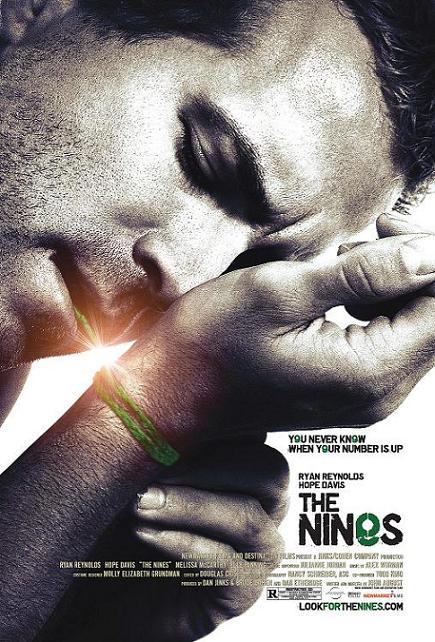
#40-The Nines (2007)


The Nines

Previously known for his writing collaborations with Tim Burton on films like Big Fish, the Charlie and the Chocolate Factory remake, and Corpse Bride, John August takes his first step into the director’s chair with The Nines. A psychological thriller comprised of three short films, all of which star the same actors as different characters, with often overlapping stories. It brings up challenging questions about author and character, actor and role, creator and creation and is like a riddle in that the question is the answer: “How does it all add up?”


The film has three principal actors, all playing three different characters as the film progresses: Ryan Reynolds plays Gary, Gavin, and Gabriel, Melissa McCarthy plays Margret, a fictionalized version of herself named Melissa, and Mary, while Hope Davis stars as Sarah, Susan and Sierra.


Gary is a troubled actor living under house-arrest in someone else’s home, who is described as “a TV writer away on work.” While there he only befriends two people, his P.R. assistant Margret, and his neighbor Sarah. As he spends his time in the house he sees different versions of himself in the building, as well as finding the number nine in everything he does. People leave the writer telephone messages about “looking for the nines” while playing backgammon, he continually rolls only nines, and even the baby monitor left by Sarah speaks of the nines during the late of night.


Gavin, the second character portrayed by Reynolds is the writer spoken about above, who is currently trying to get a new television show off the ground and into the hands of a studio. Meanwhile he recruits Melissa to play the lead actress, and is assisted by studio executive Susan. The third and final set of characters is the creation of Gavin, as we watch his TV show. Father Gabriel takes his wife Mary and their child to the canyon for a weekend getaway, but after the car battery dies Gabriel is sent to look for help, which may or may not come in the form of Sierra. Sierra is both a blessing and a curse as she continually drugs Gabriel, but also cryptically tires to convince him to “come back to reality.”


The performances by all three here are stellar. Reynolds, McCarthy and Davis all have the keen ability to play different characters all at once, and give each one of them their own personality and persona, and quickly and smoothly transition between multiple creations in the same scene. However the showstopper comes in the form of Melissa McCarthy who easily steals the spotlight when she enters frame. All of her characters are fun and sweet, and bring an emotional sense of gravity and humor to an otherwise dark film.


Though it was released by an independent studio, and had a rather small budget, the film has great production values. From a technical standpoint the film looks great. It was shot on video rather than on film and uses the limited color pallet to perfection, and computer color correction capabilities to its advantage. The first film looks really sharp and crisp, while the second looks grainy and washed out, and the third with a light tint of grey that covers each shot. The score by Alex Wurman enhances the films dreamlike quality, and it has a rollicking soundtrack guaranteed to perk the ears of viewer. Editor Douglas Crise uses the films non-linear story structure to his advantage, with editing that keeps things lively and cool, the same can be said for cinematographer Nancy Schreiber who uses the camera as a quirky way of communicating ideas and emotions to the viewer, without beating us over the head with unnecessary amounts information.


What’s most important about The Nines is its story. John August has crafted is smart, witty, and fresh creation. His dialogue is snappy, fun, and quick, full of references and little anecdotes that make it sound very real. His use of non-traditional narrative structure keeps the pacing of the film lively and never does it slow down. However, the film ends on a rather odd note, and though it gives us hints and clues along the way that allow us to piece together what is going to happen, what is happening, or what has happened (depending on your perception of the film), you’re never quite sure how it will all connect together. By the end of it you learn that the film has it’s own strange theology about the world, and questions the morality of humans, and if we can indeed transcend to become higher beings or if we are forever forced to be in a traditional human form. The ending is guaranteed to divide audiences, some are going to just say “What?” and feel cheated, and others will embrace it as a sign of the modern age, and the pain that sometimes come with it, I fall into the latter category and feel that the film is perfectly tuned into it’s audience and time period. While John August certainly is an excellent screen-writer, he defiantly shows even more potential behind the camera, and I can’t wait to see what he does next.

I Give The Nines A:
4.5/5

Saturday, October 16, 2010

#39-Martyrs (2008)

Martyrs
Recently within French cinema, there has been a new-wave of releses. These being incredibly violent, disgusting, and brutal, but also being loved by the public. This French new-wave horror cinema is trying to be remade in America, and appears to be having a similair effect to what happened with Asian horror films in 2002 when The Ring was realesed. Martyrs is one of the these films. It is sick, depraived, disgusting, brutal, violent, and unrelenting, but it is also when of the best horror films of the past decade.

Even before they begin production on a remake they must know that it is a terrible idea. The first and foremost is that the only reason for ever remaking things is to make more money on a new audience, but people who want to watch a film like Martyrs will seek it out and watch it, regardless of it being a foreign film. The second being the level of violence that is depicted in the film, which is incredible. It wouldn't appeal to a mainstream American audeince. Whereas films like Saw have violence shot in a stylized manner, Martyrs drops you in the middle of the violence and tells you to deal with it's brutality. Thirdly is the idea to cast Kristen Stewart. She's not a good actress! Who cares if she's popular and will draw people. No. Just no.

Martyrs tells the story of Anna and Lucie, two girls who have been friends since they met in an orphanage as young children. Lucie had escaped from an abusive group of scientists who ran violent experiments on many other small kids. Lucie is repeatedly attacked by a monster that has followed her since her escape. Flashforward fifteen years, and Lucie has broken into the house of a fancy family with a shotgun, and taken care of all four of them. She calls Anna for help removing the bodies. Turns one of them is still alive and is holding a secret in her basement. Lucie goes crazy and kills her, but not before discovering the family is running similair tests on a hostage in the basement to the ones Lucie went through as a child.

Writer/director Pascal Laugier has created something deeply effecting in this piece of cinema. Whether or not that is a positive or a negative I've yet to decide, as I hope to watch it again soon. In his recorded introduction to the film, he states that some days he thinks that this film is a true masterpiece, and others he wishes he had never made it in the first place. Both of these may be true. But, what cannot be denied is Laugier's excellent direction. The man can direct, and he can direct well. He has a keen ability to make his shots hyper-stylized, but not make them annoying. Similair to what I said about Peter Jackson in my Dead Alive review, he knows how to direct violence in a special way.

 Contrary to popular toture-porn horror films, which make you simply say "eww that's gross" Martyrs makes you feel it. Laugier's lens is unwavering. He knows what he is showing you, and he knows it is terrible and he just rests the camera on it until you just need to look away. When I was a bit younger (and still quite a bit today) I was an avid horror-film fan. I have seen some pretty messed-up things in my time, but rarely does violence in cinema make me uncomfortable. This proves to be an exception. There is one scene in particular -which I'll try my best not to completely ruin- that had me bringing my hands up over my eyes and peeking through the cracks of my fingers, only to see something even more vicious that I turned my head completely and just listened until the screaming stopped.  And while this may sound very dramatized it is what really happened, and when I think about the film I cannot get that sequence out of my head.


And whereas in my previous review of Deadgirl I complained about the senseless burtal violence as an ever imposing negative here it makes sense. There is a purpose to the violence that takes place within Marytrs. The payoff and explanation given for these brutal experiments that take place within the film created a conflict in me as a viewer. On one hand I  thought it was a kind of cool and interesting idea, something that had been done before, but was done different and in an interesting way to bring up so cool plot stings. However when the payoff finally did come and I realized what the movie was trying to say, I just kind of thought to myself "Oh, so that's where taking this". That was the only real flaw that I found with the movie, and it's only a sort of half-flaw. The only other one comes toward the end when they are showing the passing of time within the film. It's done in a series of really slow fade-in, fade-out shots. Normally I wouldn't mind this but the film had such a pace that when these really slow shots starting happening (and happening, and happening, and happening) it kind of drags the film down to this weird place of boredome where you just want something to happen.

The cast for he film is rather slim, only having about four or five main characters, and only having two of them on the screen for a good hour. Mylene Jampanoi who plays Lucie is incredible to watch onscreen.  She is this brutal and violent human being, but has this sort of sensitive outward appearance. You know that the reason she is crazy is because of the tests that were run on her as a child, but to sit and watch her commit acts of violence on others is something else. During the scene where she breaks into the house with a shotgun, as I described above, there is this really kind of soft and touching moment, where after killing the last person she just sits on the ground and rocks back and forth crying. It goes on for about twenty seconds, and the whole time there is just this aching within you that wants to reach out and give her a hug, even though she just massacred an entire family.

In the end, there is no denying that Martyrs is something powerful. Whether or not your morality will allow you to justify that is up to yourself. Sure it's shocking and violent and gruesome, but that isn't the films purpose. Unlike your Saws and Hostels where their violence becomes the main plot point, Martyrs doesn't. It has people that you care for, a story that you want to see through to the end and is just a well made movie. If you can stomach the brutality you will find that it is actually very poignant, sad and sweet. Lucie is one of my favorite troubled characters of recent memory. The movie in the middle is a character study, it is her story, about dealing with the trauma that she went through as a child, and about what she will have to deal with growing up. The violence is just layered around that as additions to the visceral experience. And when all is said and done it really drives you to connect with these people and watch them through to the end. So there. What is possibly one of the sickets films ever made and hype aside, I'd say it's amazing. I won't force you to see Martyrs. It's not a fun film to sit through, and it won't be to some people's taste. But for me and for what it is, Martyrs is near perfection.

I Give Martyrs A:
4/5

Friday, September 17, 2010

#37-Dear Zachary: A Letter To A Son About His Father (2008)

Dear Zachary:
A Letter To A Son About His Father

Dear Zachary is an interesting and unsettling documentary that premiered at Sundance in 2007, and has been shown on MSNBC several times since then. Created and conceived by Kurt Kuenne, he takes a camera across the country to get interviews from people who’s lives were changed by his close friend Andrew Bagby, who had been murdered by an ex-girlfriend. After many trials, re-trials, and sentences, the woman accused of murdering Bagby, Shirley Jane Turner, announces that she is pregnant with Bagby’s son. Kuenne set out to make a collective effort of love for the young boy about his father, whom he will never know, and who was killed by the woman he will be forced to live with.


This is an incredible film to watch. Defiantly not for those who are weak of heart. It is sad, heartbreaking, and very unnerving. Now, documentaries (the good ones) often prove their point enough to make you think about what the filmmakers are saying. However because there are not always main characters in documentaries, nor is there ever much narrative, it is very rare that we actually feel emotionally connected to what is going on on-screen (for me anyway). Dear Zachary is the rule-breaker. It had me in tears, it had me screaming in anger, and most importantly, it had my heartstrings, that it was able to pull and manipulate anyway that it wanted, which is exactly what it should do.


With that being said, the film is emotionally rich, but isn’t particularly well made. It feels awkwardly paced and a little choppy at times, and so many names are thrown around in such a quick amount of time, I often couldn’t remember who was who. This film was made nearly entirely on Kuenne’s own back. He did nearly everything. He is listed in the credits for: Writing, Directing, Starring, Editing, Cinematography, Producing, and doing the music for the picture. It is obvious that he had a clear vision, and made the film he wanted to make, but so many jobs for one man begins to wear down on a person, and it shows in an almost amateurish way throughout the film.


This isn’t to belittle the fact that what happened was a tragedy, and my thoughts go out to all people and parties effected, but being fair, there are better made documentaries out there. But there are few that can control its viewer as emotionally well as Dear Zachary. It’s a matter of opinion what makes a better film, feeling, our artistry, and for me it is both. But the sheer power of the story in itself, created by some well placed moments and montages, make Dear Zachary a powerhouse.
 
I Give Dear Zachary A:
4/5

Monday, August 16, 2010

#36-Where The Wild Things Are (2009)

Where The Wild Things Are


It is truly saying something, when I believe that what is quite possible one of the most important films of 2009 is based on a children’s book that has merely ten sentences in it’s entire construct. Based on the 1963 book of the same name by Maurice Sendak, Where The Wild Things are is recreated for film by also famous novelist Dave Eggers, and acclaimed director Spike Jonze.

Jonze is most notable for directing the Charlie Kaufman films, Adaptation and Being John Malkovich, (which I really need to re-watch) both of which are excellent films. Here he takes a slightly different approach adapting a children’s novel rather than some very original adult material. However, simply because it is based on a book for kids does not make Where The Wild Things are any less dramatic, adult, or important than his previous works.

Where The Wild Things Are is about a young boy named Max who is the young child of a single Mom. Max faces some of the normal calamities that strike childhood in these times, such as the single parent, a new step-parent, an older sibling and simple loneliness. All these conflicting emotions come together one night, and after a fight with his Mother, Max finally does what most children only dream of and run away. He escapes onto a boat and sails across the ocean to an island full of ‘Wild Things’ where they make Max their king, and he begins his rule.


Jonze is one of the bright young talents in Hollywood. He has made great film after great film again and again, without hitting a wrong note thus far. Jason Reitman is a director of similar talent, along with Edgar Wright, and possibly Marc Webb, depending on what his next move is. Jonze’s talent is still on display here, with Wild Things having an exceptionally cool look and feel to it. The film moves a long at a decent pace, even if there are moments when it drags, and not much is going on. The hardships of being young are captured here perfectly, and you can still feel the sting of the one painful snowball that seemed to end every fight. The emotion is incredibly rich and flowing here, with each Wild Thing representing an emotion that Max would have experienced in the real world. It is a great way of communicating ideas and themes throughout the film, without beating the audience over the head with them.


"I'm an explorer mostly"


Max Records, the young boy who plays Max does an amazing job as the films leading man. He is the only real person on screen for ninety percent of the film and carries emotion very well. He is surrounded by imaginary creatures and manages to keep himself in the correct place mentally. His performance has few of the memorable scenes in which people scream and yell, but has a more subdued feeling about that makes it even more unbelievable. The voices of the Wild Things are cool as well, coming from some extraordinary talent, including the likes of: James Gandolfini, Lauren Ambrose, Chris Cooper, Forest Whitaker, Catharine O’Hara, and Paul Dano. It also includes some small performances from Catharine Keener, as Max’s Mother, and Mark Ruffalo as her boyfriend.

The creatures look great. They are a combination of computer animation, puppetry and real life actors inside real suits. The three forms mesh together really well and create a really nice looking effect. The CGI gives them facially movement that allows them to express great emotion as each has their own personality, while the suits and puppetry make them look real, and give them a natural element.

Where The Wild Things are is simply astonishing. Jonze and Eggers manage to make their own creature from this classic story, while holding true to Sendak’s work. Jonze is a fantastic director, and knocks this one out of the park, and continues to play his career perfectly. The young boy Max Records is the most astonishing child actor I have ever seen in a film, and I think his performance deserves some recognition. He carries the entire movie on his back for over an hour and a half, and never once does his performance flinch. He is at times, angry, happy, sad, engaged, lonely and often all of them at the same time. The film captures the image of childhood in all of it’s inglorious beauty, and is often real to the point of heart break. The film is slow sometimes, but never is it boring. This is less of a children’s movie as it is a film for adults to remember what it’s like to be a child. Karen O creates some fun, if at times annoying hipster tunes that do fit the film, and the cinematography captures the wild rumpus that we have in all of us.

I Give Where The Wild Things Are A:
4.5/5

Tuesday, July 20, 2010

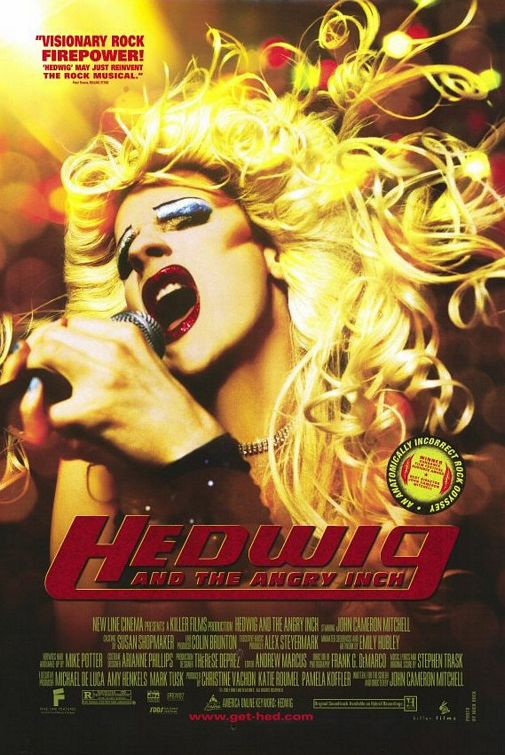
#33-Hedwig And The Angry Inch (2001)

Hedwig And The Angry Inch


Most of the films that are on my "Top Whatever" are films that I have seen years ago. This is not the case with Hedwig And The Angry Inch which I saw for the first time only about a month ago. It is based on an Off-Broadway musical written by and starring John Cameron Mitchell, who also writes, directs and stars here. The film is often compared to The Rocky Horror Picture Show for obvious reasons. A transexual main character, darkly humourous elements, and puck rock themes. It has even gotten to the point where midnight showings complete with shadow casts of the two films are shown back to back. I however, despite how much the midnight movie freak within me disagrees, can easily say that Hedwig And The Angry Inch far surpasses even the best elements of Rocky Horror.


The film is about a young boy named Hanzel (Ben Mayor-Goodwin) who is living in communist East Berlin right after the wall has gone up. Not going to school as a child, Hanzel has nothing to do but listen to American Forces Radio, where the great glam rockers of the eighties are constantly on display. David Bowie and Lou Reed being his all time favorites. By the time he has reached teenagehood, he cannot wait to get out of Berlin, and the opportunity presents itself in the form of Sgt. Luther Robinson (Maurice Dean Wint) whom falls in love with Hanzel, and Hanzel with him. The two plan to flee the country and escape then get married in America. This is impossible however because of complete cavity searches, so Hanzel's mother (Alberta Smith) gives her identity to Hanzel and gets him into a doctor to perform the operation. Unfourtanetly, the doctor cuts to short and leaves, now Hedwig (John Cameron Mitchell) with a "one inch mound of flesh". later in America, Sgt. Luther finds a new boy and leaves Hedwig on her own. To support herself she tries to become a glam rocker similair to her favorites in late 90's America, while falling in love with a strict Christain boy Tommy Speck (Michael Pitt).

Lets get this out of the way, the performance here by John Cameron Mitchell is simply fantastic. In this role he completely embodies the character of Hedwig so thouroughly it is uncanny. He was nominated for a Golden Globe for the performance and her surely deserves more recognition than that. He has a great voice that he uses to belt out some fun tunes, great comedic timing and inspiration, and a high bar of expansive dramatic set pieces that cannot be topped. His portrayal is fun, energetic and inventive, and even with wacky costumes and tons of make-up, he manages to bring out some truly deep emotion when the time is right.

The performances across the board are astonishing. Mitchell, Pitt, and Smith all perform admirably. One of Pitt's earliest performanes is a real treat to watch, since I've been enjoying his work ever since I discovered him in Funny Games. Another great, and key performance comes from Miriam Shor who plays the character of Yitzhak another character in drag, this time a woman as a man, and the back up singer in Hedwig's band, who play mostly in salad bars. There are very few other roles in the film, as the stage play was originally a one-man monolouge by whomever was playing Hedwig. The story was expanded here, and these characters being full fledge, and as such the main part of Hedwig is given the most screen time. So much screen time, there are only four supporting roles making five major roles total.
"The moutains streched up to the sky, sometimes higher"

The music in the film is awesome as well. The music was taken exactly from the play to the movie, and the songs written by Stephen Trask are infectious and addictive. They are less glam rock than say Bowie or Queen, but closer to the punk-rock hair bands of the same era. All of the band members have a great stage presence, as all the performances were done live. The songs make you want to get up and jump around, bang your head. In fact I bought the CD and have put some of the songs on my exercise playlist. When the songs are rockin', they rock, but like all great rock band's, Hedwig also has some medatative slow songs, that in all honestly make me feel connected to him. In the context of the story, and the character of Hedwig the final song: Midnight Radio is one of the greatest songs of all time, and is truly heartbreaking.

The story written my Mitchell is near percfection. It has characters we love, and side with, as well as root for and connect to. Hedwig is a truly inspirational creation and I hope there are people out there who look at this, and use it as inspiration to fufill their dreams. The screenplay is strong and unique, with flashbacks and story-tellings of an amazing ability. The direction by Mitchell proves he is more than just a pretty face for screen fame, but a great force to fight with in the directing world. In front of the camera, he is great, and behind the camera he is a genius. Mitchell might as well have redefined the medium with this film, and is someone that I am keeping a very close eye on.

The costumes and make-up are superb as well. Hedwig is a treansexual, and has to be created by make-up in that sense. But being a glam rocker he has all kinds of crazy make-up and costumes that make him a truly Bowie-an figure. Hedwig is to Hanzel, what Ziggy Stardust was to Bowie. Hedwig is sometimes a punk-rocker, a store clerk, a man, a woman, and even a bee-hive queen from '73 but what ultimatly comes out is his humanity.

Hedwig And The Angry Inch is one of the best, and one of my favorite films of all time. The inspirational story of being who you want to be, and dealing when you have to shows us that being human is not always a gift, but it is never a curse. During all of her turmoil and trouble she never gives up on her dream, and technically fufills it. One of the greatest creations in film history, potrayed by one of the best actors, and given the best platform by one of the best directors. Musically the film is a miracle, and the screenplay is phenomenal. A groundbreaking story that is humours as well as hurtful, giving us a true view of the world, whether we face the same challenges as Hedwig or not.

I Give Hedwig And The Angry Inch A:
5/5

Tuesday, July 13, 2010

#32-District 9 (2009)

District 9

The surprise hit movie that attacked theatres in the summer of 2009 is coming this way. District 9 was a surprise hit comercially when it was one of the few action films realesed that year, that wasn't already part of an established franchise. The film was also a critcal darling, using its third world message to win over even the toughest of critics. Originally a short film from director Neill Blomkamp, District 9 was action on a budget, being given only $30 Million for production, take that in comparison to Transformers 2 given $200 Million that same year.

District 9 did have some force behind it when it was realesed. It was produced, and greatly enthused by famed Lord Of The Rings director Peter Jackson. The film was also in the shaky-cam style that has grown to be quite popular and finacially success these days. Not to mention the film had great marketing tools, with 'Alien Free Zone' and 'MNU Only' signs nearly everywhere. The film may have been small but it definatly knew what it was doing, and even earned itself a Best Picture nomination at last years Academy Awards.

The story takes place on an alternate version of planet earth, where in 1982, a large alien space craft landed and floated of Johannesburg, South Africa. The aliens are kept in camps in Johannesburg, and are not allowed to speak with humans. In preperation to move the aliens or 'Prawns' as their called, a man by the name of Wikus van de Merwe (Sharlto Copley) is assigned to the job of removing, and relocating them. In a raid of one of the alien houses, he comes across a strange vile of liquid, which he accidently breaks upon and gets covered in it. What happens to him I won't say, as it is very fun to see, but as you can probably guess, it isn't something good. There in lies the story of District 9, a sci-fi action movie that is guranteed to please audiences, all the while throwing political overtones, for those willing to catch them.
"Is that cat food?"

While I did enjoy the film quite a bit, I am one to say that I don't think District 9 is that great of a film. My main problem with it was the style. I can enjoy shaky-cam mockumentary films, I think that they are fun, and if done right very enjoyable. In that sense, I think District 9 is a success. I can enjoy regular film styling, where you have multiple cameras set up to capture the action, rather than one trying to make it feel real. In that sense, I think District 9 is a success. When combining the two however, and talking about the finish product in lies the problem. The two styles have nearly become genres. I am willing to go out on a limb and call Shaky-Cam a genre over a style. And when combining these genres I don't think the finished products feels right. The film moves at the right pace, and his good camera work, but when jumping between footage of interviews telling the story of this man, and watching the story of this man actually unfold take place one right next to the other, we get a very weird clash of camera work, and therefore emotion within us that just can't seem to mesh with one another, and therefore fails.

As far as the politcal message goes, I can see what they are trying to get across. However, I also felt like this may have been an afterthought. You can see overtones of almost anything in any movie if you look hard enough for them (see my review of Avatar) and while it may have been planned, it may also not have been planned, but an accident completly. Whether or not it was there on purpose or not, I'm glad to see the message getting some attention. It could bring some very nice bright young directors to the action genre, trying to tell their story and share with us the problems our world still faces on an everyday basis. And judging on other recent action films, they definatly need a face-lift.

Sharlto Copley gives a very strong performance as Wickus. One of my favorite characters of action movies to come out recently. He is funny, intense, dramatic, and smart. He creates a character that we want to see through to the end, that we root for, and connect with. Another amazing bit that comes with District 9 is when we care for the aliens. The aliens aren't real people, the main one potrayed through technology by Jason Cope, but they are given emotion and characterists through a very strong sceenplay that also make us fall in love with them.

Based on what I've written above, it may sound like I hate the film more than I do. I actually found the film better on an entertainment level than on a critcal level, by which it is also very nice. It had great action moments, a good hero, a devilishly evil villian, a cool plot and a lot of other things going for it. Neill Blomkamp should be very proud of his work, and I see him having a very nice career in the future. Sharlto Copley and Jason Cope perform very well, the film has a great screenplay and is fun to watch. The films styling choices do hurt it, even if every so slightly.

I Give District 9 A:
4/5

Wednesday, June 30, 2010

#30-The Lovely Bones (2009)

The Lovely Bones


It is interesting to go from one of Peter Jackson’s more enjoyable films, Dead Alive, to what is possibly his worst, with The Lovely Bones (Mike called it on his comment below Dead Alive) . Once again he is in the business of adapting a novel to the big screen, this time one about a murder instead of a ring, a girl instead of a hobbit, and the 70’s instead of middle earth. And while I think that The Lovely Bones is a hard project to do, simply because you have both strong dealings with fantasy and reality, and must communicate both to the audience in a sense that makes them accessible, I just can’t help but feel like Jackson dropped the ball a little on this one.

Our story follows a young girl by the name of Susie Salmon (
Saoirse Ronan) who is living a typical teenage life in the seventies with her Mother (Rachel Weisz), Father (Mark Wahlberg), Brother and Sister. Susie is a typical young girl, loves taking pictures, is in film club, has a crush on the boy, and goes to school. Unfortunately while walking home from club one day she finds out that her neighbor (Stanley Tucci) is building a club house next to the school, ’Just a little something for the kids’ with only one rule: ’no adults allowed’. He invites Susie to be the first one inside the club house, but she never does make it out.

Stanley Tucci received an Oscar nomination for his work on the film, and I got to say, he deserves it. He plays a really creepy man thoroughly and mercilessly. He is simply terrifying to watch onscreen, as with Christoph Waltz in Inglorious Basterds (not quite there, but close) The rest of the cast does a decent job, virtual new-comer Saoirse Ronan does an okay job of playing our lead girl, and Wahlberg and Weisz perform middle ground as well, but unfortunately, their characters get pushed to the wayside by Stanley Tucci, who simply steals the spotlight whenever he appears. Rachel Weisz’s character could have been left out altogether, as could so many others, who seem to be put there for just more dialogue.

Now, what The Lovely Bones does differently from other murder mystery’s, is it puts Susie in ’the in-between’ which is a world of completely fantasy, untouched by reality, as she is able to look down and see her family, and she must remain here until her killer is caught. This is where Jackson excels, he is a great fantasy director, and he can capture leaves on a tree turning into birds and flying off well enough, but where he struggles is with the real world, which is half of the film as well. Part of the film is the family falling apart after the murder of their daughter, but I didn’t care about the family falling apart because I didn’t care about the family. They are not given enough time to tell us their story, nor are we given enough reason to care about them. All we want, or really need to see is the Tucci character interacting with them and the police. I could care less about the grandmother moving in with them, and I could care less about their marital issues, and the screenplay was not written to make you care, which unfortunately is a major flaw of the movie because it is a good chuck of its running time.

"My name is Salmon, like the fish."


Another problem that comes with the movie is the way the Tucci character is created. He is set up as the nicest guy in the world before we meet him, so we have a little tiny spec of sympathy for him, even though we know he is going to be the killer. He then proceeds to what killers do, and progressively get more and more creepy by the end of the film. What is wrong with this, is we never actually see the murder. We see a little bit of struggle and that’s it, the camera cuts away before she is actually killed, and in fact, because of the whole ‘in-between’ business, we think that she’s escaped for some time, which is a fatal mistake. Though we already dislike the Tucci character, and hate him as it is, had we actually seen the murder, had the tones been darker, had the camera been rougher, we could have really, really hated this man. I think, by the way a few of the scenes go, this movie was originally intended to be an R rated film. To be a hard-hitting make you cry kinda movie, and was later changed into a PG-13 teeny-bopper thing, which was not a good move for the film itself.

Another gigantic problem I had with it was the ending. When it happen I just stared open-mouthed at the screen and went “Really?”. I mean I won’t spoil it here, but we knew that the real world could effect the ‘in-between’, but that just took it way to far. Not only that but the way the scene was shot, it happen all to quickly, without much context, and couldn’t really effect our opinion. It was one of those rousing scenes where everyone screams in joy because of it, it was just this tacked-on little ‘oh, by the way, this happens’ which nearly killed the movie for me. Because this part was happening in the real world. In reality this never would have happened. The film needed to separate the reality and in-between to make it effective, but they just don’t pull them far enough apart, and this scene is the perfect example of this.

One thing however that I did enjoy about the film, was it had some cool camera-work at times. Such as extreme rough close-ups of his hands, and a few nice Snorri-cam shots that made the whole thing feel a lot darker for a few moments, which you know I would have appreciated. But these hardly last long enough, or are enough in general to bring the film up from the slump it had already created for itself, and it pretty much just sits for a long time, doing nothing for the audience, just sitting.

Overall, The Lovely Bones just doesn’t work. I think that the project could have been done well as an adult Fairy Tale, a sort of Pan’s Labyrinth kind of thing, but it just doesn’t. The film is too easy on the eyes in the real world, has too many characters we just don’t care about, and just sits about trying to be something that its not. Peter Jackson can be good, but his great fantasy sequences can’t overpower what should be happening in reality, which is nothing. Stanley Tucci is the saving grace here, with an excellently dark performance as the killer that we don’t see enough of, and a few shots that seemed to be from the original cut of the film also make it a tad better. I almost want to give it in the 1-ish out of five zone, but damn if Tucci didn’t give me the creeps every time.

I Give The Lovely Bones A:
2/5


Thursday, June 10, 2010

#28-Surveillance (2008)

Surveillance


Surveillance is the second film from Jennifer Lynch. Daughter of David Lynch, her career was thought to be short-lived after her debut feature Boxing Helena was received extremely negatively by both from both movie-goers and critics alike. Now, fifteen years later she tries again to break into the business her father is constantly revolutionizing, and she does so with mixed results.

If her career speaks for Jennifer Lynch thoroughly, she is never going to be as talented as her father is. This is something that needs to be stated, and known. If you go in thinking that Jennifer Lynch is going to be there for us when David passes on, I’m afraid you’re going to be wrong. Boxing Helena was obviously a film with a number of flaws, all of them nearly unforgivable. Surveillance however brings her work up a notch, and almost lets you forget about her previous film, but that however is not something very hard to do.

For all it’s worth, Surveillance certainly doesn’t have as unique of a story as Boxing Helena, but that doesn’t really matter when the other film just ended up terrible. Surveillance is about two F.B.I. agents investigating a series of murders, and a missing woman. While at the town where these vicious acts have taken place, they interrogate three people: a cocaine addicted woman, a corrupt police officer, and a little girl whose family was killed by the murderer. All three of the stories are told slightly differently through the eyes of these people, and ultimately interlock.

The film wants to, and sometimes tries, to be about the different reactions of different people when they know they are being watched by authority or peers. While it desperately wants to be deep and tell us a little something about the human psyche, and ends up falling short, and reverting to a murder-mystery tale that has a trick that we’ve seen before (different people, different stories, overall story develops through different additions ), and even has some slasher film influences, with the killers wearing creepy masks, and lots of blood making it’s way onto the screen.

"Is that your statement?"


The story is interesting enough, but it has been done before. A lot before. This idea of telling the story over and over again through different perspectives has almost begun to be normal, and the classic murder-mystery style of having one person solve it the lesser used. The mental aspect they wanted to add doesn’t work, and the twist ending easy to see coming. There is nothing specifically good with the story, but nothing specifically bad about it either.

The two main parts in the film are played by Julia Ormond and Bill Pullman, playing the F.B.I agents, and they do decently, again something that I could go either way on, there was nothing that made their roles jump out, or hold back, but I do have to admit, Bill Pullman is always kind of creepy, so it did somewhat add to the performance. Ryan Simpkins places the young girl Stephanie, and does a fantastic job for her age and part, she is easily one of the best child actors I’ve seen in awhile, and can’t wait to see more from her, in fact she is the first child to win a Best Actress award at the New York City Horror Film Festival. The film also has some other not to shabby performances from Kent Harper and Pell James.
.
Jennifer Lynch’s direction in this film is actually rather nice. She keeps the film raw and unshakeable. Never do we see anyone in the background, keeping us with a feeling of desperation a solitude, as if we couldn’t escape. A good deal of the film is set in the middle of the desert, which only enhances that effect. The office building in which the police work is desolate and empty, which though unexplained is still creepy as well. The film rapidly switches through color tonality, which gives us different feelings based on which character we’re watching and that helps the film quite a bit.

Jennifer Lynch has certainly beaten her previous offering with Surveillance, but like I said, it just doesn’t matter because almost anything could be her previous offering. She showed that she does have some skill behind the camera and can create a certain amount of emotion, but were she lacks is in directing people. The plot is ordinary, overused, and has been outdone, but is never boring, if she does another film, I will go ahead and give it a shot, but won’t necessarily look forward to it. Surveillance is a film that won’t kill you to see, but you shouldn’t kill to see it. It rests right in the middle, and is worth a rental if you were looking for it.

I Give Surveillance A:
3/5

Sunday, May 30, 2010

#27-Tideland (2005)

Tideland


Monty Pyton animator turned director Terry Gilliam makes his way onto the blog again! It’s his second time, and it hopefully it won’t be the last. He was previously on for Brazil, a film that I absoloutly loved. Tideland, one of his most recent attempts is one of his worst. I don’t think he has made a specifically bad film yet, but Tideland gets pretty close.

The story follows a young girl named Juliza Rose (Jodelle Ferland), who is the child of two very neglectful parents. Both into hard drugs, her father (Jeff Bridges) and her mother (Jennifer Tilly) are very bad for, and to her health. Having no friends being on the move constantly because of her father being a musician, she has no friends, except for her dolls. After her mother dies, and her father overdoeses, she continually escapes into a fantasy world, filled with many creepy characters and strange elements.

The film was universally panned by fans and critics alike upon intial realese. And I have to say, I don’t really disagree with them. The film is very weak for most of it’s course, having no real centerfold story, except for the life of this young girl, which we learn realativly nothing about. Her escapades into a fantasyland becomes boring after a few visits, as the movie plods along at a pretty slow rate.

The side characters are interesting and fun, more so than our main girl, which also leads to another problem, similair to the one I had with Everything Is Illuminated, where we want to see more, and are more interested in the dilemmas of the supporting cast than our leaders. Also to note, the film boasts having stars such as Bridges and Tilly, but they are hardly in the film.

Speaking of which, Jodelle Ferland gives quite possibly one of the best perfomances I’ve seen in awhile. And this is coming from someone who absoloutly hates children in film. She carries the film on her shoulders, completely on her own. But she has a very boring and plain character to play, which makes her performance something less. Nonethless, it is quite amazing.


I also applaud the films style and art direction. Its very unique in its use of special effects, and ideas. The dolls are particularly creepy, and the day/night transitions are very cool. Another thing the film has on it’s side was cinematography, which kept an otherwise slow and boring film interesting and fresh.

Overall, Tideland was a very mixed bag. The film had cool style, and an excellent lead actress. However, style cannot overcome substance, and a lackluster plot, slow story, poor character development, and pretty uninteresting people make the movie somewhat hard, and annoying to watch, it isn’t necissarily the bad, but that doesn’t make it good either.


I Give Tideland A:
2/5

Sunday, May 23, 2010

#25-Everything is Illuminated (2005)

Everything Is Illuminated


If I came into Everything Is Illuminated with one pre-conception in my mind, it would have to be skepticism. First of all, in order to be skeptical of something, for me anyway, there has to be some sort of hype behind it. Everything Is Illuminated was a critically acclaimed, but lacked any box office power, and even though critics praised the film, it was recognized at any major award hearings. The film currently has an 8/10 on IMDB. So, one could should come into this film expecting the best.

However, it did have a few things working against it. Firstly the film is written and directed by Liev Schreiber, who is known mostly for his acting career, as he became popular in the late 90's and early 00's with his work in the Scream film trilogy, and as a villian in X-Men Origins. Now, when you hand directing credits to a man whose film credits include the above films, you have to wonder what you are getting into, especially with a drama based mostly around WWII. Secondly, the film stars Elijah Wood. And while a lot of people like him, I am simply not a fan of his acting work. Sure he is decent, but he has never really stood out to me in any major roles he has performed in.

The film follows teh story of Jonathan Foer (Elijah Wood), a young Jewish man from America who sets out to find the woman who had saved his grandfather from the Holocaust. His guides are two Ukranian men, who are both slightly crazy. And elderly man, who may or may not be anti-semtic, his wannabe gangster Grandson, and a Boder Collie. The journey is to a town that his been wiped of the map called Trachimbrod, and what they find there, is utterly surprising.

Everything Is Illuminated is not a perfect film in any way, shape, or form. But it is better than I had expected going in. The film is slightly compassionate in its imperfections and I was greatly surprised by Schreiber's directorial skills. The film is based on a short-story of the same name, which I haven't read, and therefore cannot compare, I do however want to read it after seeing the film, which is definatly a postive.


"I am premium dancer"

Elijah Wood does better than expected in a rather tough role to play, being caught in a foreign land with many stranger people and things, and no one to really get along with. His performance is good, but not great, as I have come to expect from him. It may have been better had he not needed to compete with much more interesting supporting characters. Eugene Hutz gives an amazingly exaggerated performance as Alex, the younger of his two guides, who keeps things light, and humourus. another strong performance comes from Boris Leskin, who plays the grandfather, and who does a lot of the emotional heavy lifting towards the end of the film, instead of Elijah Wood, which was an interesting choice, but not one that worked well.

The music in the film was also very appreciated, with some fun songs by Russian punk band Leningrad, and some rousing scores from compser Paul Catelon. I must also praise the artist and mastery of the cinematography by Matthey Libatique, who keeps things very vivid in an otherwise slow and rather depressing film. When things need to be dark he also keeps the colors very light, even though in black and white. And only keeps the color red, which adds a very cool Schindlers List effect.

In no way is this film anywhere near the real of Schindlers List. Schreiber does a better job directing than expected, but it's easy to tell that he still could make it better with the films odd pace, a simple narrative that becomes rather confusing, and a very loose sense of direction. This is all fixed within the final few scenes of the film, but the rest is sometimes slow and hard to watch.

Everything is Illuminated is a decent WWII film, that rarely touches on WWII. For its unique choice and great techincal aspects, I applaud it. But all the emotion and comedy comes from supporting characters who have more of a role to play than our lead actor. Eljiah Wood is only semi-convincing as our main character, but is more deminished by an amazing performance from eugene Hutz. Schreiber isn't a bad director, in fact he is a very good one, especially for his first feature, but he can definatly improve, and I can't wait to see what he does next.

I Give Everything Is Illuminated A:
3.5/5